No, Lenin did not die of syphilis
For a hundred years a rumour has outlived every document that contradicts it. The autopsy, the laboratory tests, the doctors' own notes and the Ulyanov family's deaths all point one way.
Achintyarup Ray ·
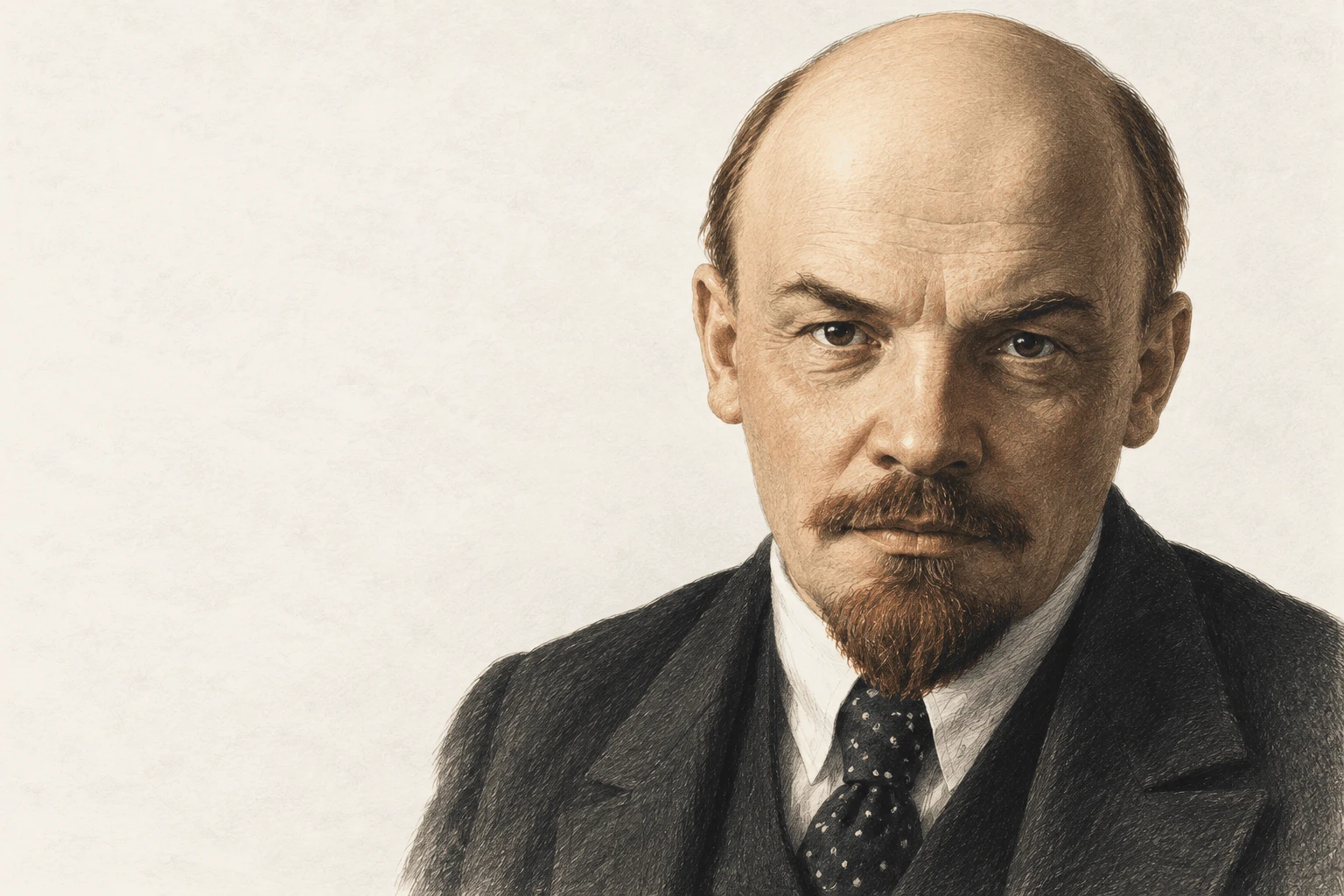
The sound of stone
On the afternoon of 22 January 1924, the day after Vladimir Ilyich Ulyanov died at Gorki, the pathologist Alexei Abrikosov opened his skull. What the men in the room remembered afterwards was a sound. When a prosector tapped the arteries at the base of Lenin’s brain with his forceps, they rang as though he were tapping stone.1 The People’s Commissar for Health, Nikolai Semashko, who stood at the table, later wrote that the vessels were so damaged that the forceps drew a metallic note, and that their channels had narrowed to less than the width of a hair.2
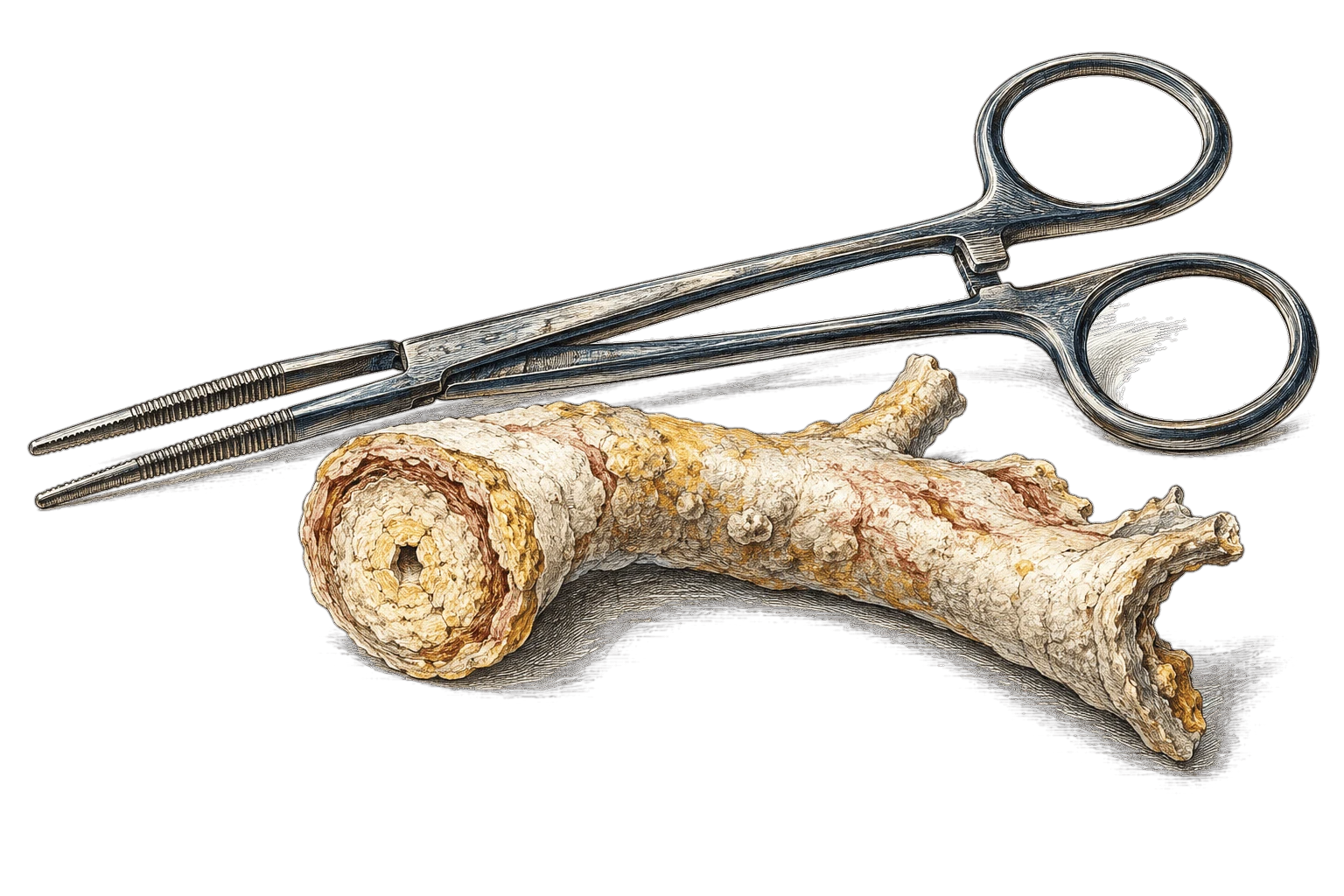
The written protocol, published in Pravda on 25 January, is duller and more exact. The left internal carotid artery, where it enters the skull, had no channel left at all; cut across, it was “a homogeneous solid whitish band”. The arteries at the base of the brain were hardened, thick-walled, and narrowed in places to a slit. The descending aorta was studded with yellowish plaques, some ulcerating. The left hemisphere of the brain was riddled with old softenings turning into cysts. The anatomical diagnosis: widespread arteriosclerosis, worst in the arteries of the brain. The conclusion: the disease rested on “premature wearing out” of the vessels, and the immediate causes of death were a worsening of the circulation to the brain and a fresh haemorrhage into the membranes over the midbrain.3
That is what the record says. What people have said, for a hundred years and counting, is that Lenin died of syphilis.
This piece is about the gap between the two.
A rumour older than the corpse
The syphilis story was already in the air while Lenin was alive. It travelled by word of mouth inside Soviet Russia and in print outside it. The first published version is usually credited to Vladislav Terebinsky, who had run the department of skin and venereal diseases at Saratov University before emigrating to the Balkans during the Civil War, where he wrote a pamphlet reading the autopsy protocol as a case of lues cerebri, syphilis of the brain. He had no access to Lenin’s medical papers.4 Émigré writers — Boris Solonevich in 1958, Nikolai Valentinov in 1971 — kept it going through the Cold War.4
The modern revival has three main sources.
In 2004 three Israeli psychiatrists and neurologists, Vladimir Lerner, Yoram Finkelstein and Eliezer Witztum, published “The enigma of Lenin’s (1870–1924) malady” in the European Journal of Neurology. It is the only peer-reviewed paper in English that argues for neurosyphilis, and nearly every popular article on the subject leans on it.2
In October 2009 the historian Helen Rappaport, promoting her book Conspirator: Lenin in Exile, told the Daily Telegraph that Lenin had probably caught syphilis from a Paris prostitute around 1902. The story went round the world. Her evidence, as reported, was a remark attributed to the physiologist Ivan Pavlov about a revolution made by a madman with syphilis of the brain, and a remark attributed to the diplomat Vatslav Vorovsky to an Italian colleague.5 Neither man was among Lenin’s physicians. A scholarly review of the book noted that she offered no definitive evidence, and that what Lenin showed in the crucial months of 1922–23 were the symptoms of recurring strokes.6
The third, and the most serious, is the Moscow geriatrician Valery Novoselov. In 2017 the Russian State Archive of Socio-Political History (RGASPI) let him read, “by way of exception”, the 410-page typed diary kept by Lenin’s attending physicians from 28 May 1922 to his death. He has argued since, in interviews and most fully in a January 2024 article in the Russian history magazine Istorik, that the diary proves Lenin was treated for, and died of, meningovascular neurosyphilis.78
Any honest answer has to take these arguments at their strongest. So let us start there.
The case for syphilis
Put fairly, the argument runs like this.
He was treated for it. From July 1922 the diary records injections of arsenic compounds — salvarsan and its relatives, the standard anti-syphilitic drugs of the day — along with courses of iodine, mercury rubs, and from March 1923 bismuth. Novoselov counts at least five courses of arsenicals, continuing into the last months.7 Nobody disputes this.
The syphilis specialists were summoned. In March 1923 the Politburo widened the consilium of doctors. Among those who came was Max Nonne of Hamburg, author of the standard textbook Syphilis und Nervensystem and the leading German authority on the late forms of the disease.4
Some doctors suspected it. Adolf von Strümpell of Leipzig, another of the foreign consultants, wrote in his diary on 20 March 1923 that syphilitic inflammation of the arteries with softening of the brain was “very probable”, though unproven. Lerner and colleagues add that the Russian neurologists Vasily Kramer and Alexei Kozhevnikov also suspected syphilis, and that neither signed the autopsy protocol.2 Novoselov reports that in May 1923 Vladimir Bekhterev said the process was not atherosclerotic.7
The clinical picture fits. Meningovascular syphilis — the form in which the infection inflames the arteries of the brain — most often strikes the territory of the middle cerebral artery, producing exactly Lenin’s pattern: weakness of one side, loss of speech, seizures.9 Lenin was young for strokes, did not smoke, was not diabetic, was not fat.10
The state wanted it hidden. On 24 January 1924 Semashko wrote a memo saying the doctors thought it better to mention the absence of any sign of syphilis in the forthcoming microscopy report rather than the autopsy protocol. The microscopy report duly carried a paragraph, written “in view of circulating rumours”, declaring that there was no indication of syphilis in the history, the blood and spinal fluid tests, or the autopsy.7 Lerner and colleagues, citing Russian sources, say Semashko instructed Abrikosov to prove Lenin had not had syphilis, and that blood-test results are missing from the archive although the records show blood was drawn repeatedly.2
The documents stayed locked. Under Russian law, medical records are closed for 75 years, which should have opened the diary in 1999. That year, at the request of Lenin’s niece Olga Ulyanova, the federal archive service extended the restriction for another 25 years, to 2024. Novoselov went to court to have it lifted and lost.11
That is a real case. It is also, examined piece by piece, a case built almost entirely on what doctors feared and did, and hardly at all on what they found.
Treating is not diagnosing
The single most important fact about the diary is one Novoselov himself concedes: the word “syphilis” does not appear in it. There is no diagnosis anywhere in the document. He infers the disease from the treatment.47
But in the 1920s, treatment was how doctors asked the question. Syphilis was extremely common — Novoselov’s own figures put signs of past infection in 5.5 per cent of Moscow autopsies and in as much as 6 per cent of the RSFSR’s population — and it could imitate almost anything.8 The clinical rule of the era, repeated in textbooks, was in dubio suspice luem: when in doubt, suspect syphilis.4 A middle-aged man with headaches, fainting spells and one-sided paralysis would be given arsenicals whatever his doctors privately believed, because the cost of missing treatable syphilis was catastrophic and the drugs were the only test that could be run on the living disease. Lenin himself, by several accounts, did not rule it out and was willing to take salvarsan.4
The foreign expert brought in precisely to settle the matter settled it the other way. Nonne later wrote, in words quoted in Russian scholarship on the case, that absolutely nothing had pointed to syphilis.4 Novoselov has said that Nonne kept silent for the rest of his life out of medical discretion; the quotation says otherwise.4
Strümpell’s diary, the source Lerner and colleagues rely on for suspicion, is also the source for its collapse. By his own account the joint consultation considered syphilitic arteritis likely but could not confirm it because the spinal fluid was normal and the Wassermann test was negative; they discussed brain tumour and subdural haematoma as alternatives, and his final note was that the diagnosis was uncertain.2 Suspicion, tested and not confirmed, is the opposite of proof.
There is a further, darker point in Novoselov’s own material. He quotes the diary entry for 4 August 1922: an arsenical injection of 0.3, then, while Lenin lay talking, a sudden silence, chewing movements of the lips, and within minutes paralysis of the right arm and leg. He notes that later “spasms” also tended to follow arsenical injections.7 If he is right about the timing, what the diary documents is not the course of syphilis but the side-effects of treating a man for a disease he may not have had.
What the tests said
The Wassermann reaction, introduced in 1906, was the laboratory test for syphilis available to Lenin’s doctors. It was run on his blood and on his cerebrospinal fluid. Every contemporary account that survives says the same thing: negative.
- Strümpell recorded a normal spinal fluid and a negative Wassermann.2
- Solomon Henschen of Stockholm, reporting to the Swedish Medical Society on 26 February 1924, said the cause might be a common, non-specific one, since the Wassermann test on the spinal fluid was negative.2
- A recent neurological review of the case records that a syphilis test after the first stroke was negative.12
- The physicians’ statement attached to the microscopy report in 1924 says no sign of syphilis appeared in the blood or spinal fluid examinations.7
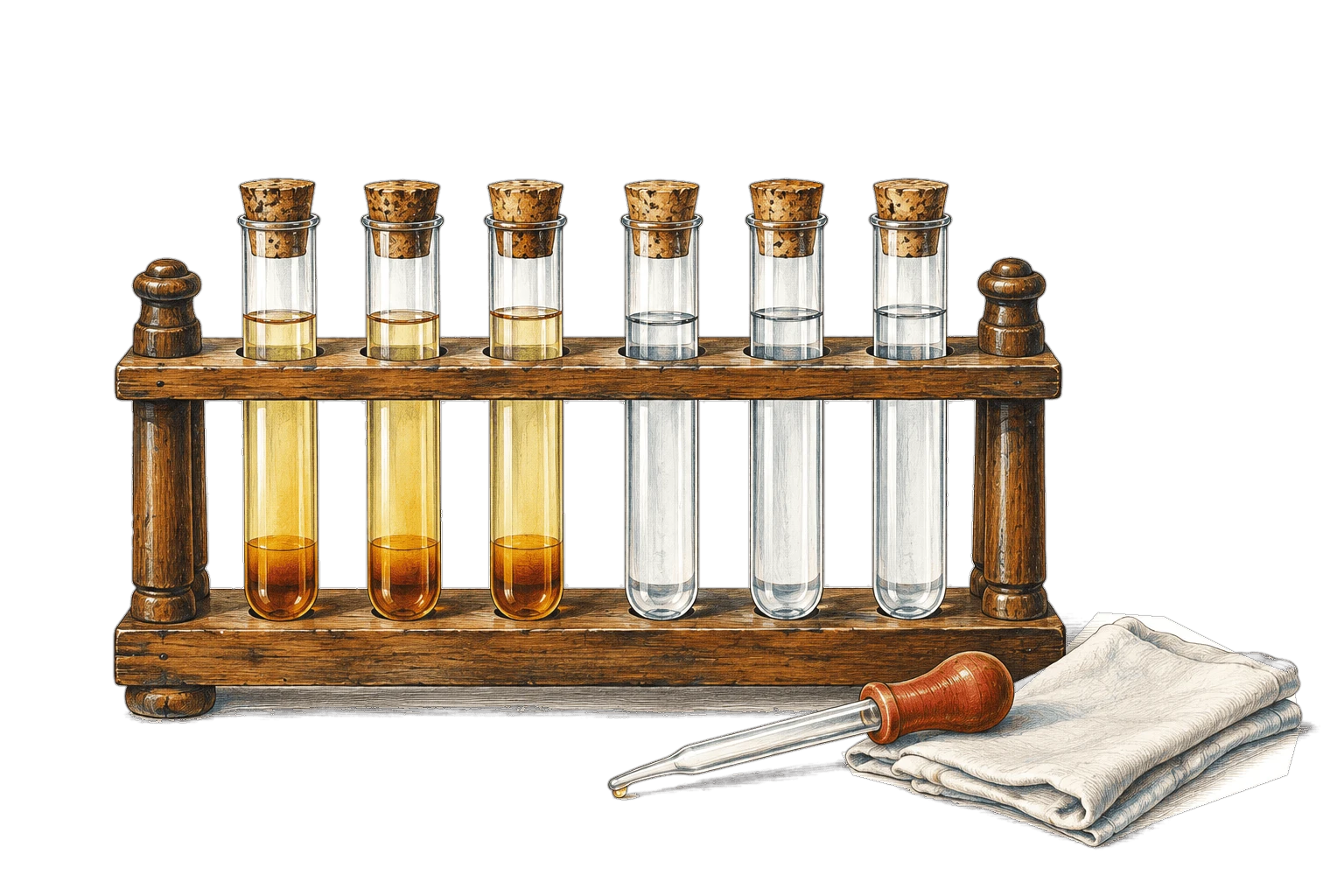 Blood Wassermann negative, tested repeatedly Spinal fluid normal; Wassermann negative
 - Blood — Wassermann negative, tested repeatedly
- Spinal fluid — normal; Wassermann negative
The syphilis theorists have two answers. The first is that the Wassermann test on spinal fluid can miss late syphilis; Lerner and colleagues give a false-negative range of 34 to 90 per cent.2 That is fair as far as it goes, and it is also true that a normal cell count in spinal fluid does not rule out the disease: in H. Houston Merritt’s classic 1946 series, 37 per cent of patients with cerebral meningovascular syphilis had fewer than ten white cells per millilitre.13 No single test was conclusive.
But the same paper supplies the counterweight. In late syphilis, the authors write, the blood Wassermann gives a false negative in only about 5 per cent of cases.2 Lenin’s blood was tested repeatedly. To keep the syphilis theory alive one has to assume that a patient with active, fatal neurosyphilis, severe enough to obliterate a carotid artery, fell into that 5 per cent on every draw, while also having normal spinal fluid.
The second answer is that the blood results are missing and may have been suppressed. That is a legitimate gap in the file. But the people who ran the tests included foreigners who went home to Hamburg, Breslau, Leipzig and Stockholm, far beyond the reach of the GPU, and lived for decades. Nonne died in 1959.14 Not one of them ever said the tests had been positive. The one who wrote about it said the opposite.
What the eyes said
There is a small, telling detail in Novoselov’s own transcription of the very first diary entry, of late May 1922, which he quotes to show the doctors’ concern: “Pupils equal, react well to light.”7
The classic eye sign of late neurosyphilis is the Argyll Robertson pupil: small, irregular pupils that do not constrict to light but still constrict when the patient focuses on something close. In tabes dorsalis, the spinal form of late neurosyphilis, pupillary abnormalities are found in over 90 per cent of patients.9 It is not present in every form of the disease, and its absence proves nothing by itself. But it is striking that the document offered as proof of neurosyphilis opens by recording a normal version of one of its best-known signs.
The same entry records that his memory and judgement were normal. So did Henschen, who examined him with Strümpell in March 1923 and found him coherent, cooperative, following every instruction, his intellect apparently intact behind the aphasia.2
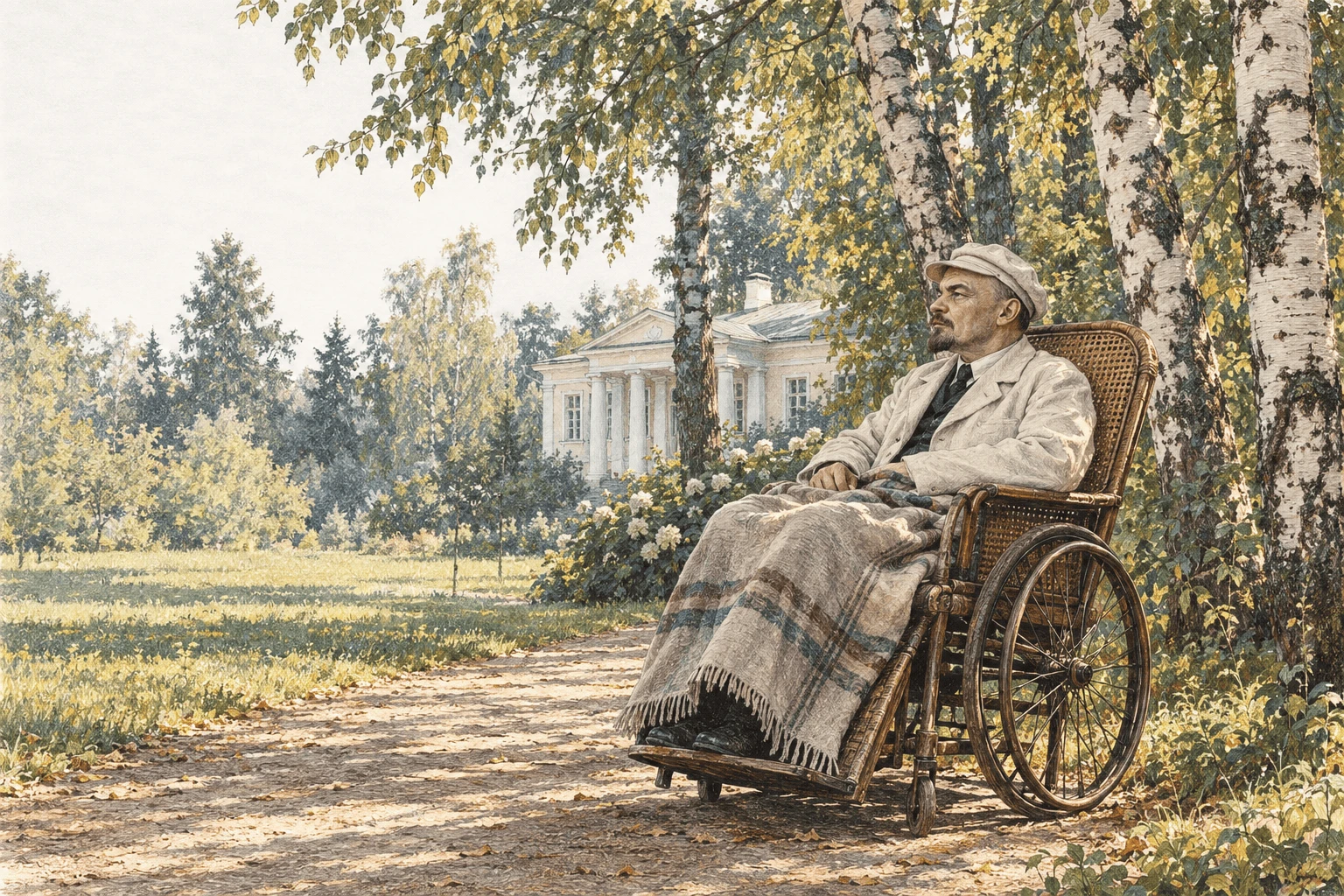
General paresis — the “progressive paralysis” of Pavlov’s alleged remark — is a dementing illness. Lenin was dictating articles and letters until March 1923 whose argument, whatever one thinks of it, is not the work of a demented mind.
What the knife found
A living patient can hide a diagnosis. A body on the table cannot, and in 1924 the man with the knife was the best person in Russia to read it. Abrikosov was the country’s leading pathologist; he later wrote the standard multi-volume Soviet handbook of pathology, and in 1942 received the Stalin Prize for its volume on the heart and blood vessels.15 He knew exactly what syphilis does to arteries, because in the 1920s every pathologist saw it every week.
Syphilis and atherosclerosis damage arteries in different ways and in different places.
The aorta. Cardiovascular syphilis is overwhelmingly a disease of the ascending aorta and the arch — the first curve of the great vessel as it leaves the heart. Because the infection travels in the tiny vessels that feed the thicker arterial walls, it is confined to the thoracic aorta and spares the abdominal aorta.16 Its signatures are a dilated ascending aorta, aneurysm, and a leaking aortic valve. The Lenin protocol records none of these. What it records is arteriosclerosis of the descending aorta, with prominent yellow plaques, partly ulcerated and calcified.32 That is the textbook picture of atherosclerosis. The UCLA neuropathologist Harry Vinters, reviewing the autopsy for the University of Maryland’s historical clinicopathological conference in 2012, pointed out that none of the other tell-tale signs of syphilis — damage to the heart or bones — were found.121
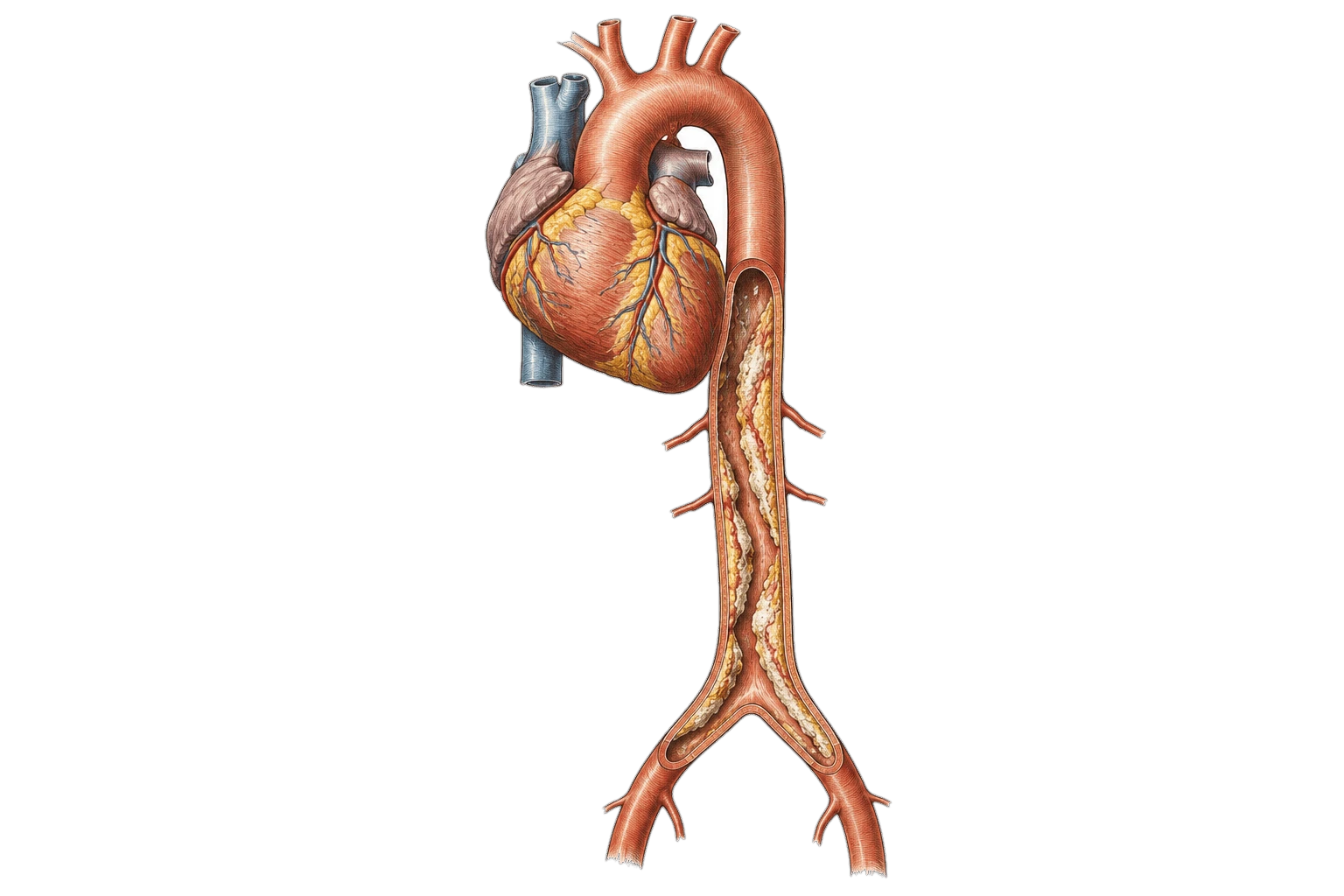 Ascending aorta and arch where syphilitic aortitis strikes. In Lenin: no aortitis recorded Descending aorta in Lenin: yellow plaques, ulcerated, calcified Abdominal aorta spared by syphilis; the classic site of atheroma
 - Ascending aorta and arch — where syphilitic aortitis strikes. In Lenin: no aortitis recorded
- Descending aorta — in Lenin: yellow plaques, ulcerated, calcified
- Abdominal aorta — spared by syphilis; the classic site of atheroma
The brain’s arteries. Meningovascular syphilis produces what pathologists call Heubner’s arteritis: an inflammatory disease in which the inner lining of large and medium arteries thickens with fibrous tissue, the muscular middle layer thins, and the outer coat fills with inflammation and scar, usually alongside thickened, inflamed meninges.17 It narrows arteries by swelling and scarring. It is not known for turning them into calcified pipes that ring under forceps. Vinters concluded that the size and location of Lenin’s brain lesions hardly corresponded to what is seen in neurosyphilis.12
Under the microscope. On 14 February 1924, after the tissue had been sectioned, Abrikosov signed a further conclusion: the microscopic examination confirmed the autopsy, the sole basis of all the changes was atherosclerosis of the arterial system, and no indication of a specific process — syphilis or anything else — had been found in the vessels or any other organ.4
Lerner and colleagues object, via the Russian writer Yuri Lopukhin, that the microscopy sampled atypical sites and ignored the ones syphilis typically attacks.2 The full slide list is not in the public domain, so this cannot be checked in detail. But the objection does not touch the gross findings, which describe the carotid, vertebral and basilar arteries and the aorta at length, and find in them atheroma, not arteritis.
The signatures. The protocol was signed by Abrikosov and nine others, including Otfrid Foerster of Breslau, the German neurologist who had treated Lenin since 1922.3 Novoselov makes much of the fact that one physician present, Fyodor Getye, did not sign.7 An unsigned name is an absence; it is not testimony. Foerster’s signature is a presence, and he, too, returned to Germany and never retracted it.
The word. Novoselov has argued that the key term in the conclusion, Abnützungssclerose — sclerosis from wear and tear — was invented for the occasion and appears nowhere else.18 It does not. The fact-checkers at Provereno.Media found it in a German multi-volume work on pathological anatomy published in 1911.4 It was a real, if old-fashioned, category: the idea that arteries simply wear out.
In 1991 Boris Petrovsky, a surgeon and former Soviet health minister, reviewed the original case history, the autopsy protocols and the microscopy for the journal of the USSR Academy of Sciences. His conclusion was that the documents determine the diagnosis exactly: atherosclerosis of the left carotid artery, softening of the brain, and a terminal haemorrhage near the vital centres.19 This was written after glasnost, when there was no longer any political penalty for saying otherwise.
The Ulyanov inheritance
If not syphilis, why would a non-smoking, lean man in his early fifties have arteries like an old man’s? The autopsy itself, oddly, begins by calling the body that of an “elderly man”.7
The most useful evidence is his family.
- His father, Ilya Nikolaevich Ulyanov, a senior school inspector, died in Simbirsk in January 1886 of a brain haemorrhage at the age of 54.1210 Lenin died in January 1924, three months short of his 54th birthday.
- His younger sister Maria died in Moscow on 12 June 1937, aged 59. The official medical conclusion, published in Izvestia two days later, gave the cause as atherosclerosis of the vessels of the brain.20
- A 2021 review in Case Reports in Neurology notes that three of Lenin’s siblings died of cardiovascular disease.12
 Ilya Ulyanov father · stroke · 54 Vladimir Lenin atherosclerosis · 53 Maria Ulyanova sister · atherosclerosis · 59
 - Ilya Ulyanov — father · stroke · 54
- Vladimir Lenin — atherosclerosis · 53
- Maria Ulyanova — sister · atherosclerosis · 59
A father dead of a stroke at 54, a son dead of cerebral atherosclerosis at 53, a daughter dead of cerebral atherosclerosis at 59: that is a family pattern, and it is the kind of pattern syphilis — an infection acquired by an individual — cannot produce. The neurologists who have looked at the case most recently suggest an inherited disorder of lipids, or a rare genetic calcifying disease of the arteries such as the NT5E mutation described in 2011, with the stress of the revolutionary years as an accelerant.121 None of these can now be proved. But each is consistent with the autopsy, which syphilis is not.
One more piece of the old gossip deserves a line. The German historian of medicine Hünter Hesse argued that Lenin and Krupskaya’s childlessness pointed to venereal infection.2 Krupskaya had Graves’ disease, visible in her photographs as goitre and bulging eyes, and was operated on for it by Theodor Kocher in Bern in 1913.21 Graves’ disease is a well-known cause of disrupted fertility. The childlessness needs no syphilis to explain it.
Why the rumour will not die
If the evidence is this lopsided, why does the story keep coming back?
Partly because the Soviet state lied about Lenin’s health from the first day, and people who are lied to learn to believe the opposite. In July 1922 Lenin himself read the official bulletins on his condition, which blamed a gastro-intestinal disorder, and laughed. He scrawled a note to Kamenev with the words: “Lie, but know the limit!”7 On 22 January 1924 the government announcement of his death said his health had been improving and nothing had pointed to the end.7 A state that issues bulletins like these forfeits the benefit of the doubt, and the space it leaves is filled by rumour.
Partly because syphilis made a better story. It turned the founder of the Soviet state into a moral cautionary tale — the revolution as the product of a diseased brain. That version suited émigrés in the 1950s, it suited Cold War journalism, and it still suits the headline writer.
And partly because the secrecy was real. Semashko’s memo shows officials anxious to kill the rumour, and the 1999 extension of the archive ban looked, to anyone predisposed to suspicion, like something being hidden. Anxiety to refute a rumour is not evidence that the rumour is true. It is exactly what one would expect from a government that knew a slander was circulating and had the autopsy in hand to answer it.
A last caution about the sources. The Lerner paper, for all its footnotes, dates the assassination attempt on Lenin to 1919 (it was 30 August 1918) and his death to 24 January 1924 (it was the 21st).2 Its most colourful testimony — Pavlov’s diagnosis, and his claim that researchers had found syphilitic changes in Lenin’s brain — comes secondhand from a 1987 article in Grani, an émigré magazine.2 Pavlov was a physiologist, not one of Lenin’s physicians. The man who actually led the study of the brain, Oskar Vogt, published conclusions about its large pyramidal cells and pronounced Lenin an “athlete of association”; he reported no syphilis.22
What is still missing

Nothing here closes every door, and the record has gaps worth naming.
The blood-test results are not in the published file. The full microscopy sampling has not been published. The physicians’ diary, restricted until the centenary of Lenin’s death on 21 January 2024, has been quoted only in fragments, by one researcher who was not allowed to photocopy it.117 Whether RGASPI has opened it since 2024 is something a researcher should now ask the archive directly.
The poisoning theory also still has a hearing. The St Petersburg historian Lev Lurie argued at the 2012 Maryland conference that Stalin may have hastened the end, and Vinters allowed it as a possibility; no toxicology was ever done.10 That is a separate question from syphilis, and the autopsy is compatible with a man who was dying of his arteries either way.
And Lenin’s brain is still in the Moscow Brain Institute, sectioned into tens of thousands of slides.22 Lerner and colleagues suggested that DNA methods might one day settle the question.2 They are right, and it cuts both ways: if anyone ever finds Treponema pallidum in that tissue, this piece is wrong. Until then, the burden of proof sits with those who claim it is there.
The ledger
| Claim | What the record shows |
|---|---|
| He was treated with salvarsan, mercury, bismuth | True. Standard practice to treat possible syphilis; the diary names no diagnosis. |
| Syphilis specialist Nonne was called in | True. He later wrote that nothing pointed to syphilis. |
| Strümpell thought syphilitic arteritis probable | True in March 1923; his own diary records normal spinal fluid, negative Wassermann, and an uncertain diagnosis. |
| Wassermann tests were negative | Blood and spinal fluid, per Strümpell, Henschen, and the 1924 physicians’ statement. Blood results not in the published file. |
| Pupils | First diary entry: equal, reacting well to light. No Argyll Robertson sign recorded. |
| Aorta | Atheroma of the descending aorta. No ascending aortitis, aneurysm or valve damage, the signatures of cardiovascular syphilis. |
| Brain arteries | Calcified, atheromatous, carotid obliterated. Not the inflammatory picture of Heubner’s arteritis. |
| Microscopy, 14 Feb 1924 | Atherosclerosis only; no specific process in any organ. |
| Family | Father dead of brain haemorrhage at 54; sister dead of cerebral atherosclerosis at 59; three siblings dead of cardiovascular disease. |
| Foreign doctors bribed to silence | Paid large fees; none ever alleged syphilis; Nonne, Henschen and Strümpell left accounts that point the other way. |
The syphilis theory rests on what Lenin’s doctors feared and what they tried. The atherosclerosis diagnosis rests on what they measured and what they found. A hundred years on, those are still the only two kinds of evidence there are, and only one of them is evidence of a cause of death.
Footnotes
-
Harry V. Vinters, Lev Lurie and Philip A. Mackowiak, “Vessels of stone: Lenin’s ‘circulatory disturbance of the brain’”, Human Pathology 44 (2013): 1967–72. https://doi.org/10.1016/j.humpath.2012.11.017 ↩ ↩2 ↩3
-
V. Lerner, Y. Finkelstein and E. Witztum, “The enigma of Lenin’s (1870–1924) malady”, European Journal of Neurology 11 (2004): 371–376. https://doi.org/10.1111/j.1468-1331.2004.00839.x. Includes the Strümpell diary (published by his daughters, Frankfurter Allgemeine Zeitung, 1974) and Folke Henschen’s account of his father’s report (FAZ, 1974). ↩ ↩2 ↩3 ↩4 ↩5 ↩6 ↩7 ↩8 ↩9 ↩10 ↩11 ↩12 ↩13 ↩14 ↩15 ↩16
-
Autopsy protocol of V. I. Ulyanov (Lenin), signed by A. I. Abrikosov and others, published in Pravda, 25 January 1924. Anatomical diagnosis and conclusion as reproduced in Pavel Solakhyan, “Правда ли, что Ленин умер от сифилиса?”, Provereno.Media, 30 June 2022, and in Radio Svoboda, 27 January 2019. Gross findings summarised in Lerner et al. 2004 (below). Translations mine. The Pravda issue should be checked in facsimile before publication. ↩ ↩2 ↩3
-
Pavel Solakhyan, “Правда ли, что Ленин умер от сифилиса?”, Provereno.Media (IFCN signatory), 30 June 2022. https://provereno.media/blog/2022/06/30/pravda-li-chto-lenin-umer-ot-sifilisa/. Source for Terebinsky; Abrikosov’s 14 February 1924 conclusion; the Nonne quotation (from Nonne’s memoirs, Anfang und Ziel meines Lebens, Hamburg 1971, via the Russian magazine Znanie — Sila); the 1911 use of Abnutzungsklerose. Page reference in Nonne’s memoir to be verified. ↩ ↩2 ↩3 ↩4 ↩5 ↩6 ↩7 ↩8 ↩9 ↩10
-
Nick Britten, “Vladimir Lenin died from syphilis, new research claims”, Daily Telegraph, 22 October 2009; as reported by ANI/Oneindia, 23 October 2009. ↩
-
Review of Helen Rappaport, Conspirator: Lenin in Exile (Basic Books, 2010), in The NEP Era: Soviet Russia 1921–1928, p. 70. University of Minnesota Conservancy. ↩
-
Valery Novoselov, “От чего умер Ленин?”, Istorik no. 109, January 2024. https://историк.рф/journal/post/7184. Source for diary excerpts (first entry; 4 August 1922), treatment courses, Semashko’s memo of 24 January 1924, the physicians’ statement in the microscopy protocol, Lenin’s note to Kamenev, and the government announcement of 22 January 1924. ↩ ↩2 ↩3 ↩4 ↩5 ↩6 ↩7 ↩8 ↩9 ↩10 ↩11 ↩12 ↩13
-
Andrei Sharogradsky, interview with Valery Novoselov, Radio Svoboda, 27 January 2019. https://www.svoboda.org/a/29728069.html ↩ ↩2
-
“Neurosyphilis”, MedLink Neurology (2025). Middle cerebral artery predominance in meningovascular syphilis; pupillary abnormalities in over 90 per cent of tabes dorsalis. ↩ ↩2
-
Associated Press report on the University of Maryland historical clinicopathological conference, 4 May 2012, as carried by NBC News and The Moscow Times. ↩ ↩2 ↩3
-
“Суд отказался рассекретить дневники врачей и санитаров Ленина”, Znak.com, 31 March 2018; also Kommersant, 3 March 2018. ↩ ↩2
-
Norbert Nighoghossian, Tae-Hee Cho and Laura Mechtouff, “Lenin’s Stroke”, Case Reports in Neurology 13 (2021): 384–387. https://doi.org/10.1159/000515657 ↩ ↩2 ↩3 ↩4 ↩5 ↩6
-
Figures from H. H. Merritt, R. D. Adams and H. C. Solomon, Neurosyphilis (1946), as cited in “Neurosyphilis: Knowledge Gaps and Controversies”, Sexually Transmitted Diseases (2018). PMC5808573. ↩
-
Max Nonne, 13 January 1861 – 12 August 1959. ↩
-
Biographical details of A. I. Abrikosov (1875–1955), including the 1942 Stalin Prize for Private pathological anatomy, part II: the heart and blood vessels. ↩
-
“Treponema pallidum: A Forgotten Pathogen With Major Cardiovascular Consequence”, JACC: Case Reports (2024). https://doi.org/10.1016/j.jaccas.2024.102575 ↩
-
“The re-emergence in Canada of meningovascular syphilis: 2 patients with headache and stroke”, CMAJ. PMC1877856. ↩
-
Interview with Valery Novoselov, Gazeta.ru, 14 May 2023. ↩
-
B. V. Petrovsky, “Ранение и болезнь В. И. Ленина”, Vestnik Akademii Nauk SSSR, 1991, no. 2, p. 114. Quoted in Provereno.Media, above. ↩
-
“Медицинское заключение”, Izvestia, 14 June 1937, no. 138, p. 1. To be checked in the original. ↩
-
“The rebel thyroid of a revolutionary First Lady”, Journal of Endocrinological Investigation (2019). https://doi.org/10.1007/s40618-019-01113-7. See also Maria Alexandrovna Ulyanova to Maria Ilyinichna, 30 April 1913, in Lenin, Collected Works, note to letter 236. ↩
-
“Lenin’s Brain”, history pages of the Max Planck Institute for Brain Research, Frankfurt. https://brain.mpg.de/institute/history/lenins-brain.html ↩ ↩2