Mrs Mukherji, the Nazi from Calcutta
In March 1949 an Indian officer watched a Calcutta editor’s wife give the Nazi salute in a Düsseldorf court, and recorded, at second hand, a remark she was said to have made about Hitler. The file Delhi marked for destruction shows what the Government of India did next, and what her husband did not.
Achintyarup Ray ·
“…she told the Public Safety Officer that her biggest ambition was to get a baby from Adolf Hitler, and she believes that he is still alive.”
— Major T. P. Francis, Indian Military Mission, Berlin, report of 22 March 1949. His sentence begins “It appears that”: he is recording at second hand a remark she was said to have made to a British officer
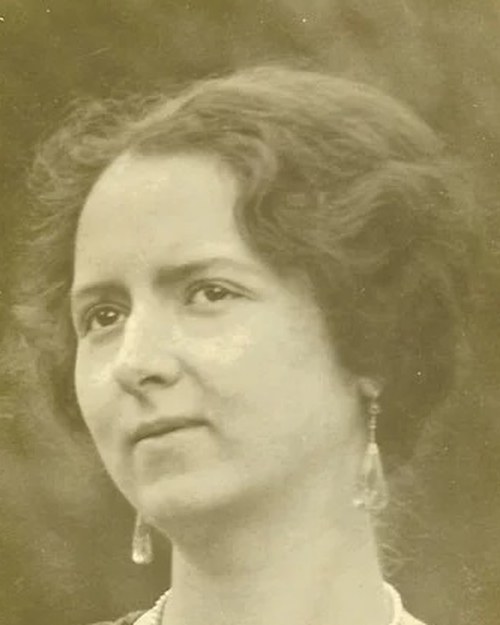

Left: Maximiani Portas, later Savitri Devi, as a young woman in France. Date unknown. Courtesy: savitridevi.org. Right: Adolf Hitler. Photograph: Bundesarchiv, Bild 183-S33882 / CC-BY-SA 3.0.
It was a smoggy November evening in Kolkata. On Harish Chatterjee Street, a few buildings from the heavily guarded home of Mamata Banerjee, then West Bengal’s chief minister, I stood before a huge padlocked iron gate in near-darkness. Behind it was the Hindu Mission, founded in the mid-1920s to convert non-Hindus to Hinduism. I peeped through a crack but saw only black. Nobody could say who ran the place. Hesitantly, I dialled a number scraped off the internet, and someone actually picked up. Soon a courteous man arrived with an aide and unlocked the gate.
 The courtyard of the Hindu Mission, Harish Chatterjee Street, Kolkata. Photograph: Achintyarup Ray, November 2017.
Inside it was dark. They switched on a few “tube-lights”, waking sleeping pigeons. A long, pillared hall, shedding plaster, opened onto a courtyard strung with faded paper Indian flags. In one shrine, a marble Buddha sat beneath a hymn declaring him an incarnation of Vishnu, one of Hinduism’s principal gods. In another, a life-size, blue-skinned Vishnu stood garlanded beside the founder’s portrait.
 The pillared hall of the Hindu Mission. Photograph: Achintyarup Ray, November 2017.
The man in the founder’s portrait is named on its mount: Srimat Swami Satyananda Saraswati. Bengal’s Special Branch in 1938 called him “the militant Missionary leader.” His Mission campaigned for shuddhi, bringing converts to Christianity and Islam back into Hinduism (in today’s language, ghar wapsi, or “homecoming”), and for Hindu unity, and from 1930 worked among the Namasudras, a caste then treated as untouchable.
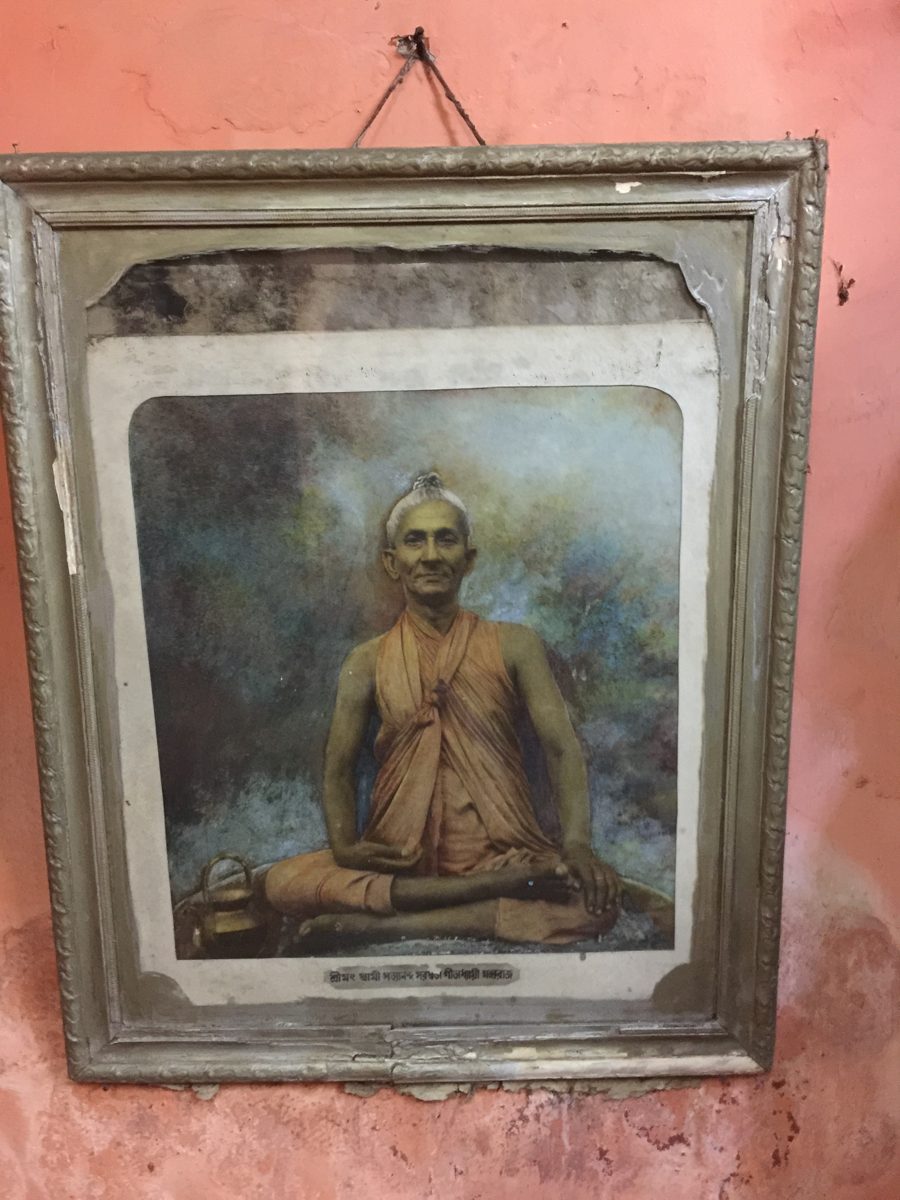 Swami Satyananda Saraswati, in the portrait that hangs at the Hindu Mission. Photograph: Achintyarup Ray, November 2017.
By her own account to British police in 1949, it was for this Mission that a European woman calling herself Savitri Devi worked in the late 1930s. In 1939 the Mission published her A Warning to the Hindus, with a foreword by Ganesh Damodar Savarkar, elder brother of V. D. Savarkar. Whether Satyananda shared her Hitler-worship depends on whose account you read, and every version traces back to her own writings.
Ten years after the Mission published her pamphlet, she stood in a courtroom in occupied Germany. She was brought into the Summary Court at Düsseldorf at about twelve o’clock on Monday, 14 March 1949. Before the proceedings began, she turned to the press benches and gave them the Hitler salute.
In the gallery sat Major T. P. Francis, consular officer of the Indian Military Mission in Berlin. He had been sent to watch because the defendant, on paper, was an Indian. She was Mrs Savitri Devi Mukherji, wife of Asit Krishna Mukherji of 1 Wellesley Street, Calcutta. Eight days later he typed up what he had seen.
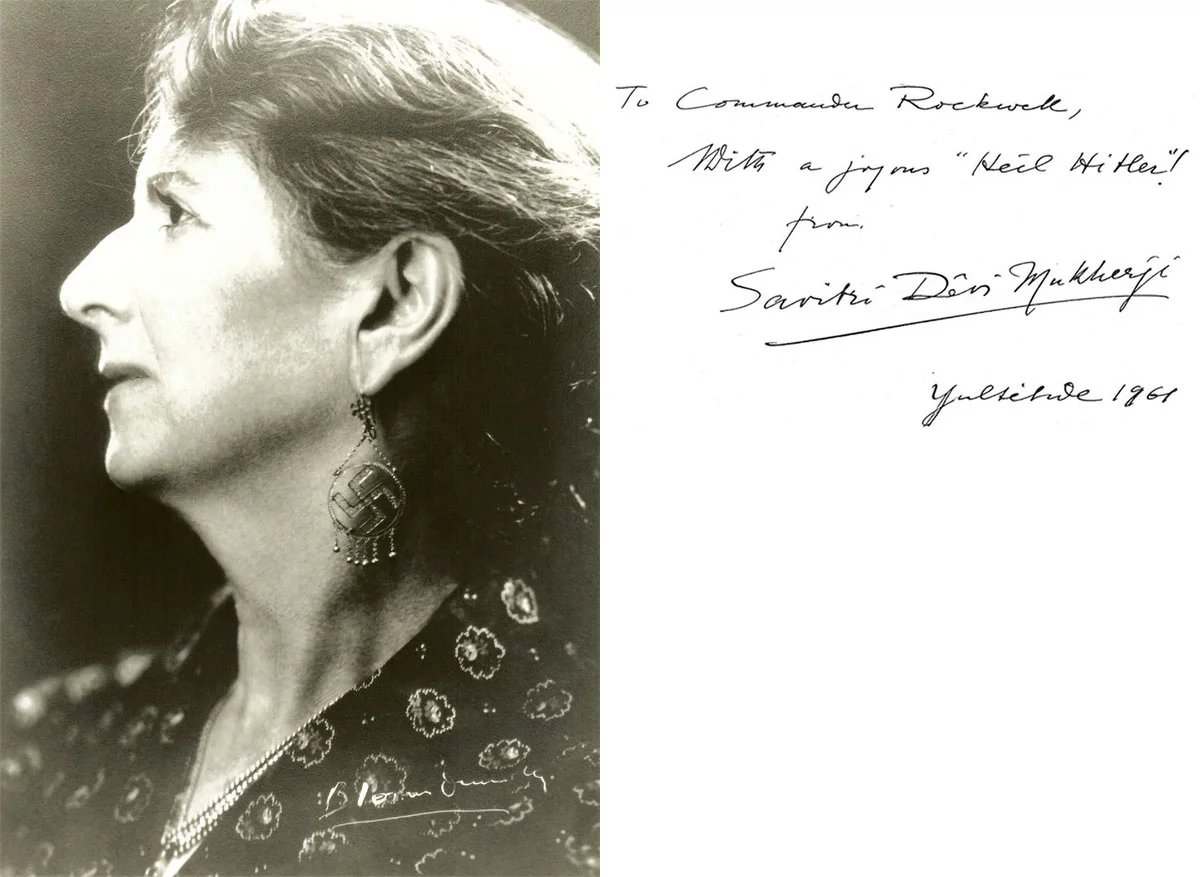 Savitri Devi, wearing a swastika earring, in a photograph she inscribed with her married name to George Lincoln Rockwell, founder of the American Nazi Party, Yuletide 1961. Courtesy: savitridevi.org.
His two pages survive in a Ministry of External Affairs file at the National Archives of India, where I found them: File No. 12(23)-Eur.II/49 (Secret), “Trial and deportation of Mrs Savitri Devi Mukherji from Germany” and “question of repatriation of Mrs Mukherji to India.” On the cover, in red, someone wrote Destroy after year 1959. Nobody did.
This post is about that file. It does not retell her life. The world now knows her, through her admirers and her critics, as Savitri Devi: born Maximiani Portas in Lyon in 1905, a mystic of Hitler-worship, one of the earliest deniers of the Holocaust, and in recent years a figure revived by the online far right. Most of that story rests on what she wrote and said about herself. The file is something else. It is what officials in Düsseldorf, Berlin, New Delhi, Poona and Calcutta wrote about her while it was happening.
 Savitri Devi in Delhi, 1980. Courtesy: savitridevi.org.
To her husband’s nephews in Calcutta she was Savitri Mami. In 1969 Sumanta Banerjee, the journalist and Asit Mukherji’s nephew, got a phone call at home from a colleague: a peculiar European woman had turned up at the office claiming to be his aunt. He went and found her in a sari with a saffron border and large swastika earrings, and knew at once it was Savitri Mami. She had heard he had married, and married a Muslim, and she wanted to see his wife. Then, as he told BBC Radio 4 in 2017, she took a plastic ruler out of her bag and measured his wife’s nose. Her verdict: “She is more Aryan than you. You have made a good choice.” Banerjee had already written about her in The Times of India in 1999, under the headline “Memories of my Nazi Maami.”
What the Indian officer saw
Francis’s account is the only eyewitness record of the hearing by someone with no stake in her cause.
She faced three charges. The first was entering the British Zone of Germany illegally. The second was holding foreign currency she should have deposited within three days of arrival: one Bank of England £5 note and about 1,500 French francs. The third was attempting Nazi propaganda “to keep alive the Hitler-myth and cause disaffection among the German population.” Francis recorded that the third offence was punishable by death.
She was, he wrote, “extremely bold” and “only too willing to give evidence against herself.” Before the judge could call a witness, she wanted to make a speech. Five witnesses gave evidence: her co-accused, a woman from the railway mission at Cologne station, the German police officer who arrested her, a senior German police inspector and a British Public Safety officer. Each time she was asked if she wished to cross-examine, she said their statements were “perfectly correct.” When a leaflet was read aloud in court and reached the words “Heil Hitler,” she gave the salute again. Throughout, Francis noted, she kept looking at the press “for signs of admiration.”
At the end, refused her speech, she said she was “perfectly proud of whatever she had done and was perfectly willing to face any consequences.” She signed the statement in court.
Then comes the line quoted at the top of this post. It is not her own words. It is Major Francis, in his report of 22 March 1949, recording at second hand something she is said to have told a British officer. Here is the sentence exactly as he typed it:
“It appears that she told the Public Safety Officer that her biggest ambition was to get a baby from Adolf Hitler, and she believes that he is still alive.”
Francis put the remark in an official report to his government. That he did so is a fact. Whether she said it, in those words, is not established.
Francis also recorded that there was “no indication, whatsoever, that she was an irresponsible person,” and that she “lives in a world of her own.” His own verdict is in his last paragraph, from an officer of the Government of India: “Although she deserves the death penalty I was told that she may at the most be given a few months’ imprisonment and then be ordered to be deported to India.”
“I am only too pleased to speak”
Tucked inside the file is the report Francis relied on. It was written by the Public Safety Department of the British administration for North Rhine-Westphalia, dated 28 February 1949 and signed by R. G. James.
It records how the case began. On the morning of 14 February, four Nazi posters appeared on the wall of Cologne’s Town Hall. That afternoon a policeman arrested a man handing out the same pamphlets. He was Gerhard Wasner, 27, who had volunteered for the SS Totenkopf Division and served in it from 1939 to 1945. Wasner said a woman he had met by chance at Cologne railway station had given him the leaflets. She had told him she was an extreme National Socialist. On 20 February a witness picked her out and German police arrested her. Copies of another pamphlet were found in her possession.
When she was cautioned, the report quotes her reply in full:
“I am only too pleased to speak. It is not only the keeping alive of the Military Spirit but keeping alive and furthering the whole of National Socialist consciousness, which in my eyes is something far broader than just Military Spirit, something in fact that exceeds Germany and exceeds our times.”
The report then gives an account of her life, and it says plainly that this account came “from MUKHERJI herself.” That matters. What follows is not what the British established. It is what she told them.
She said she left France for India in 1932, after her father died. She said she taught philosophy and Indian history in the Punjab, worked for the Hindu Mission in Calcutta, and became a Hindu in 1936. She said she married Asit Mukherji on 29 September 1939 “for the sole purpose” of getting a passport, so that she could reach Germany through Italy and broadcast propaganda for the Germans in French, Greek and Bengali. She said Italy’s entry into the war in 1940 stopped her. She said she spent the war years in Calcutta doing Air Raid Precautions work. The officer added that she “gives the impression” that she and her husband worked for the Japanese, “although she has not stated so.”
That last sentence is worth pausing on. In her later books and interviews she said the couple had passed Allied military information to Japanese intelligence. In February 1949, under caution, eager to confess, she did not say so to the British. One fair reading is that she was not going to admit wartime espionage to British police, since a British subject who said it would have been confessing to something far worse than leafleting. Another is that the story grew later. The file cannot decide between them. It does show that the espionage claim was not part of her first detailed account of herself.
The papers found on her lead into a British circle, not a German one. There were letters from a man in Jersey urging her to write for the Kingdom Herald, which the British officer described as “a Fascist publication.” There was correspondence routed through a group calling itself the Legion of Christian Reformers. And there was a letter from Surrey advising her to contact people “persecuted under 18b”, meaning the British fascists interned during the war. Among her papers were also three chapters of a book in progress, Gold in the Furnace, dedicated to “The Martyrs of Nurenberg.”
How her story became the government’s facts
On 5 April 1949 the Control Commission High Court at Düsseldorf sentenced her to three years’ imprisonment and recommended her for deportation. In New Delhi, the question was whether India had to take her back.
The official handling it, P. A. Menon, Joint Secretary in External Affairs, wrote on the same day that she appeared to have come to India in 1932. He also wrote that she had married Mukherji “with the sole purpose of getting a passport to travel to Germany.” Both statements come straight from the British report, and so from her.
India’s own records said something different about the first. A Bengal Special Branch note of 1940, in a separate 1944 file I traced at the National Archives, records her arriving at Dhanushkodi on 17 May 1935. Delhi never checked. By October 1949 the Ministry was telling the Indian Embassy in Paris, as settled fact, that she had married Mukherji on 29 September 1939. In April the same date had been what she “claims.”
“Unless we are forced to do so”
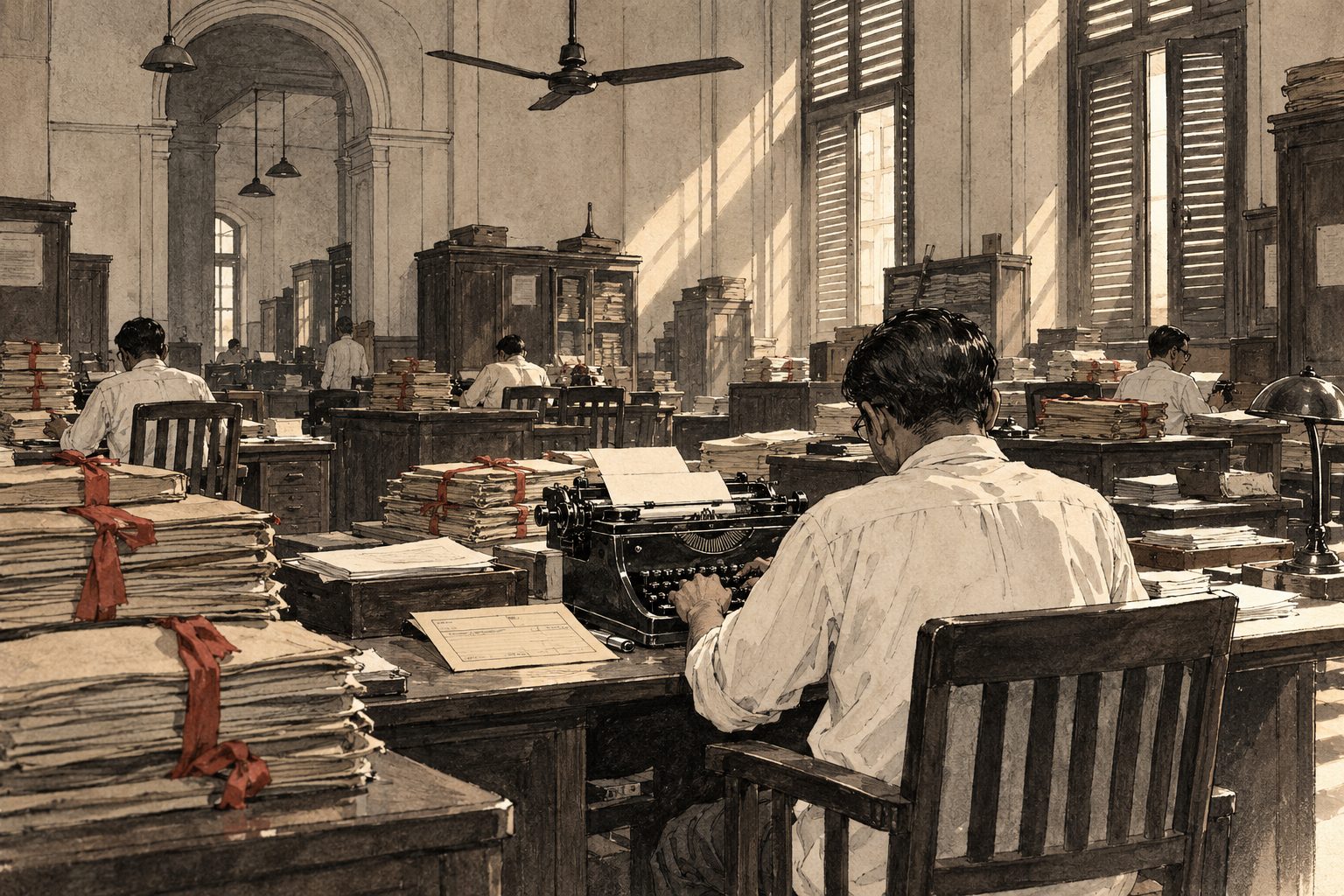 AI-generated illustration: New Delhi, 1949.
Delhi did not want her. Menon questioned whether she was really Indian at all. He also saw no reason for India to pay; deporting people it found undesirable was, he thought, the British Zone’s own expense. The Home Ministry agreed that the wife of an Indian was to be treated as Indian, but only if the marriage was legally valid. One of its deputy secretaries, F. Singh, went further on 14 April:
“…Mrs. Mukherji who for all practical purposes is a foreigner except that she married an Indian to suit her own convenience. We are also not likely to gain anything by admitting an undesirable foreigner of the type of Mrs. Mukherji. In the circumstances, I venture to suggest that we should not accept Mrs. Mukherji, unless we are forced to do so.”
He noted that under the Foreigners Act, 1946, she could still be treated as a foreigner. On 20 April a confidential telegram, copied to the Prime Minister’s office, told Berlin: “Pending verification she will NOT be admitted into India.”
On 28 April the Home Ministry telegraphed Calcutta. It asked the West Bengal government to verify the marriage, and also to find out “whether ASIT MUKHERJI acknowledges SAVITRI DEVI as his wife or they have since separated.”
Poona speaks for her
Only one Indian voice appears on the file in her defence, and it came from Poona, not Calcutta. On 15 April 1949 G. V. Ketkar, editor of Tilak’s Marathi paper Kesari, telegraphed the Prime Minister asking him to “inquire and mediate for release.” In his follow-up letter he argued that she was a vegetarian, opposed to all cruelty to animals. “It is unthinkable that she would think of the alleged Nazi propaganda,” he wrote, and suggested others might have used the covers of her books to smuggle leaflets. Kesari urged the government to press for her sentence to be commuted.
A month earlier, in open court, she had called every statement against her “perfectly correct.”
Calcutta answers, and the price is set
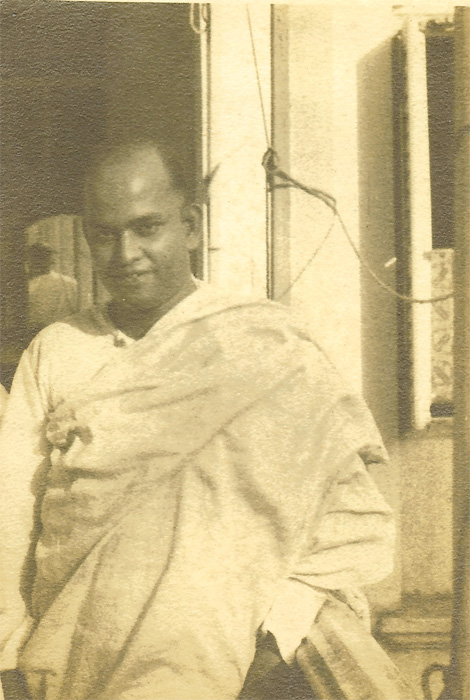 Asit Krishna Mukherji, Calcutta, undated. Photograph: Wikimedia Commons.
On 28 May West Bengal replied by telegram. She was the “LEGALLY MARRIED WIFE OF ASHIT KRISHNA MUKHERJI WHO IS PREPARED RECEIVE HER IN INDIA AND MEET REPATRIATION CHARGES.”
Delhi then agreed to take her back, on terms. Her husband was to deposit the cost of the cheapest passage with the Reserve Bank of India, so that foreign exchange could be released. The actual repatriation, the Ministry instructed, “should take place only after the deposit of the money by her husband.” In August the figure was fixed at Rs 1,067, equivalent to £80.
The British lose patience
On 25 August 1949 E. L. Watkins of the British administration’s Zonal Executive Offices at Lübbecke wrote to Francis. The authority responsible for deportations had decided that “even if the Indian Government did give clearance for Mrs. Mukherji to return to India it would be a very difficult matter to effect deportation.” Instead it issued an expulsion order, which “would permit her release from prison forthwith.” On 18 August 1949 British civil police escorted her to the French Zone and handed her to the French gendarmerie. She went to her mother’s house at 107 Rue Bossuet, Lyon.
She had been in custody since 20 February, so she served just under six months of a three-year sentence.
 AI-generated illustration: 18 August 1949, handed to the French gendarmerie.
On 3 September Ketkar wrote again, from the Kesari and Mahratta office. He had heard “from Dr. A. K. Mukerji of Calcutta” that she had been “released unconditionally.” He thanked the Ministry for its “successful intervention in the matter.” The British letter records no Indian intervention, and the release came with an expulsion order attached. On 23 September the Ministry replied that the Government of India “have agreed to the repatriation” and that “necessary arrangements are being made.” By then she had been in France for five weeks.
The idea of an Indian rescue has lasted. A 2017 BBC profile of her says her imprisonment was “cut short by her husband’s intervention through the Indian government.” The file does not bear that out. It holds no record of any such intervention. The British decided to release her for their own reasons, and Delhi’s only commitment was conditional on money her husband had not yet paid. As the next two papers show, he never paid it.
“There is no question of repatriation now”
Asit Krishna Mukherji’s own words appear in the file only once. On 29 October 1949 he wrote from 1 Wellesley Street to the Deputy Commissioner, Special Branch, Calcutta:
“My wife, Mrs. S. Mukerji, has gone back to Lyons (France) at her mother’s house. There is no question of repatriation now. She will stay there for some time.”
On 11 November West Bengal informed Delhi that he was “not willing to deposit the amount of Rs.1067/-.” The last paper on the file is dated 28 November 1949. It asks the Embassy in Paris to let the Ministry know “if and when Mrs. Mukherji approaches you for assistance to repatriate her to India.”
The Government of India spent eight months working out how not to receive her, and in the end it did not have to. Her husband promised to pay for her passage and then did not. The British let her go because deporting her was too much trouble. She lived another thirty-three years, wrote the books that made her a prophet to people like her, and died in Essex in 1982.
The Bureau’s memory of her had already shrunk by then. In February 1944 the Intelligence Bureau had written that her husband had received funds from the Japanese Consulate in Calcutta, and that she should on no account be allowed to leave India during the war. In June 1949, clearing her return, the same Bureau summed her up in one line: anti-British, and had met some Communists around 1939. “Since then she has not come to adverse notice.”
What Delhi already knew
The Government of India did not meet her for the first time in 1949. Its own files had been following her for a decade.
In 1939, before the war began, a secret printed list of “Indians under suspicion”, compiled for military intelligence, entered her as “Savitri Devi, Miss Mazimiani M. Portaz a Greek lady”, of 8 Esplanade East, Calcutta: “Connected with Italian propaganda.” Another entry named “Mukherjee, A. K., Editor, ‘New Mercury’”, and recorded that in April 1936 the German Consul General had been pleased with the paper and promised to recommend it to German advertisers. A third named a “Dr. Ashit Mukherji of Bengal Publicity Service, Calcutta”, “subsidised by the German and Italian Consulates to carry on pro-German and Fascist propaganda, and anti-British propaganda.” The list does not say whether this is the same man.
Calcutta’s police saw someone else. In 1940 Bengal’s Special Branch, recommending that she be refused a passport to Europe, described her as fanatical and violently anti-British, a favourite of young nationalists and an admirer of the Chittagong revolutionaries. It said nothing about Nazism. A secret report that year recorded that she “was married to Dr Asit Mukherji, the Communist.”
In February 1944 the Intelligence Bureau said she must on no account leave India while the war lasted. Six weeks later it changed its mind: she had not come to adverse notice for four years, and the security authorities in London had dropped their objections. Those four quiet years are the years in which, by her later account, she and her husband were passing Allied military secrets to Japan.
Why she is back
Savitri Devi died in obscurity in 1982. Her revival began in the West, where a white-nationalist publisher reissued her books and the alt-right borrowed her language; in 2025 Prospect reported alt-right groups on X “increasingly promoting” her views.
Ask Sumanta Banerjee why she matters in India, and his answer is blunt. “Her disciples are ruling India today,” he says. “The members of the present Modi-led BJP government have imbibed Savitri Devi’s ideology.”
That is a nephew’s verdict, and a polemic, and the record supports only part of it. There is no evidence that BJP leaders read her, cite her or count her among their influences; the historian Koushiki Dasgupta finds that her racial scheme won few followers even in 1930s Calcutta. What the record does show is a shared ancestry. In 1938 V. D. Savarkar said Germany had “every right to resort to Nazism.” In 1939, the year the Hindu Mission published her pamphlet, We, or Our Nationhood Defined appeared under the name of M. S. Golwalkar, later the RSS’s longest-serving chief, praising Germany for “purging the country of the semitic races”; in 1963 Golwalkar disowned it, calling it an abridgement of a book by Ganesh Damodar Savarkar, the man who wrote the foreword to her pamphlet. The historian Marzia Casolari, working from archives, traces how Hindu nationalists of the 1930s took the idea of an “internal enemy” from European fascism. The RSS is the parent body of the BJP.
For decades those ideas sat on the margins. With Narendra Modi’s victory in 2014, Hindutva moved from the fringe into national government; in May 2026 the BJP won West Bengal, where she once worked for the Hindu Mission, for the first time. Banerjee’s word “disciples” overstates the line of descent: she joined a current that was already flowing, and did not start it. But the current she joined is now in power.
None of this makes her a founder of anything. Her Calcutta project failed, and there is no record of the BJP or the RSS claiming her. But the file shows a government, in 1949, that knew exactly what she was and wanted nothing to do with her.
Documents
National Archives of India, MEA File No. 12(23)-Eur.II/49 (Secret), 1949:
- Major T. P. Francis, notes on the proceedings of 14 March 1949, dated 22 March 1949
- Land Public Safety Department, North Rhine/Westphalia, report of 28 February 1949 (copy)
- MHA and MEA notes and telegrams, April–November 1949
- Letters of G. V. Ketkar, 15 April, 2 June and 3 September 1949
- E. L. Watkins, Zonal Executive Offices, Lübbecke, 25 August 1949 (copy)
- A. K. Mukerji to D.C., Special Branch, Calcutta, 29 October 1949 (copy)
- Government of West Bengal, Home (Passport) Department, 11 November 1949
Other records:
- NAI File No. 210(16)-G/44 (Secret), External Affairs Department, 1944: the 1940 Bengal Special Branch note and the 1944 Intelligence Bureau notes
- “Potentially hostile foreigners” / “Indians under suspicion”, printed list, Most Secret, c. 1939 (stamp No. 524/6/M.I.7)
Published accounts and context:
- Maria Margaronis, “Savitri Devi: The mystical fascist being resurrected by the alt-right,” BBC News Magazine, 28 October 2017
- Sumanta Banerjee, interviewed in “Savitri Devi: From the Aryans to the Alt-right,” BBC Radio 4, 2017
- Marzia Casolari, “Hindutva’s Foreign Tie-up in the 1930s: Archival Evidence,” Economic and Political Weekly, 22 January 2000
- Koushiki Dasgupta, Vidyasagar University Journal of History, vol. VII, 2018–19
- Simran Thapliyal, Prospect, 28 January 2025
Quotations are from the documents as typed. Illustrations marked AI-generated are imaginative reconstructions, not records; documents and photographs are reproduced as found.