The Noose and the Song
A story about the elephant trappers of Assam — the men who caught wild elephants by hand, tamed them with ropes and songs, and mastered a trade the state first licensed, then let vanish under them.
Achintyarup Ray ·
I never finished the essay. I want to say that before anything else, because it explains why this piece exists at all.
The clouds were coming down off the Arunachal hills the day I met him, dark and rolling, the way a herd of wild elephants moves when it moves together — unhurried, enormous. Below them, lay the Dullung forest, with cicadas keeping up their flat, droning racket in the wet heat, the smell of rain-fed undergrowth so thick that you could almost taste it. Eighty-five-year-old Bapuram Shaikia was standing at the exact spot where his hut used to be, and he was crying. Not the tears of a man performing grief for a visiting reporter. The kind that just runs, down the creases of a very old face.
He had a working name that had, by then, replaced his own. Boro phandi — senior trapper, master of the craft — worn so long that the title had become the man, the way “Lalji” had long since stopped being a nickname for Prakritishchandra Barua and become the only name anyone in that world used for him.
I started writing about him once. I got as far as the crying and stopped. The essay sat unfinished for so long that when I finally went back to apologise to whoever was still waiting for it, I had to reach for an old Bengali way of admitting that too much time had passed — a lot of water gone down the Gandak since I began. This is that essay, finished, sixteen years too late, with everything I have now that I did not have then, including — because I owe him this much — what actually happened when I asked him about the old days.
What mela shikar actually was
Before any of that, a word needs explaining, because I have watched people nod along to it for years without really knowing what it means, and I am not going to do that to you.
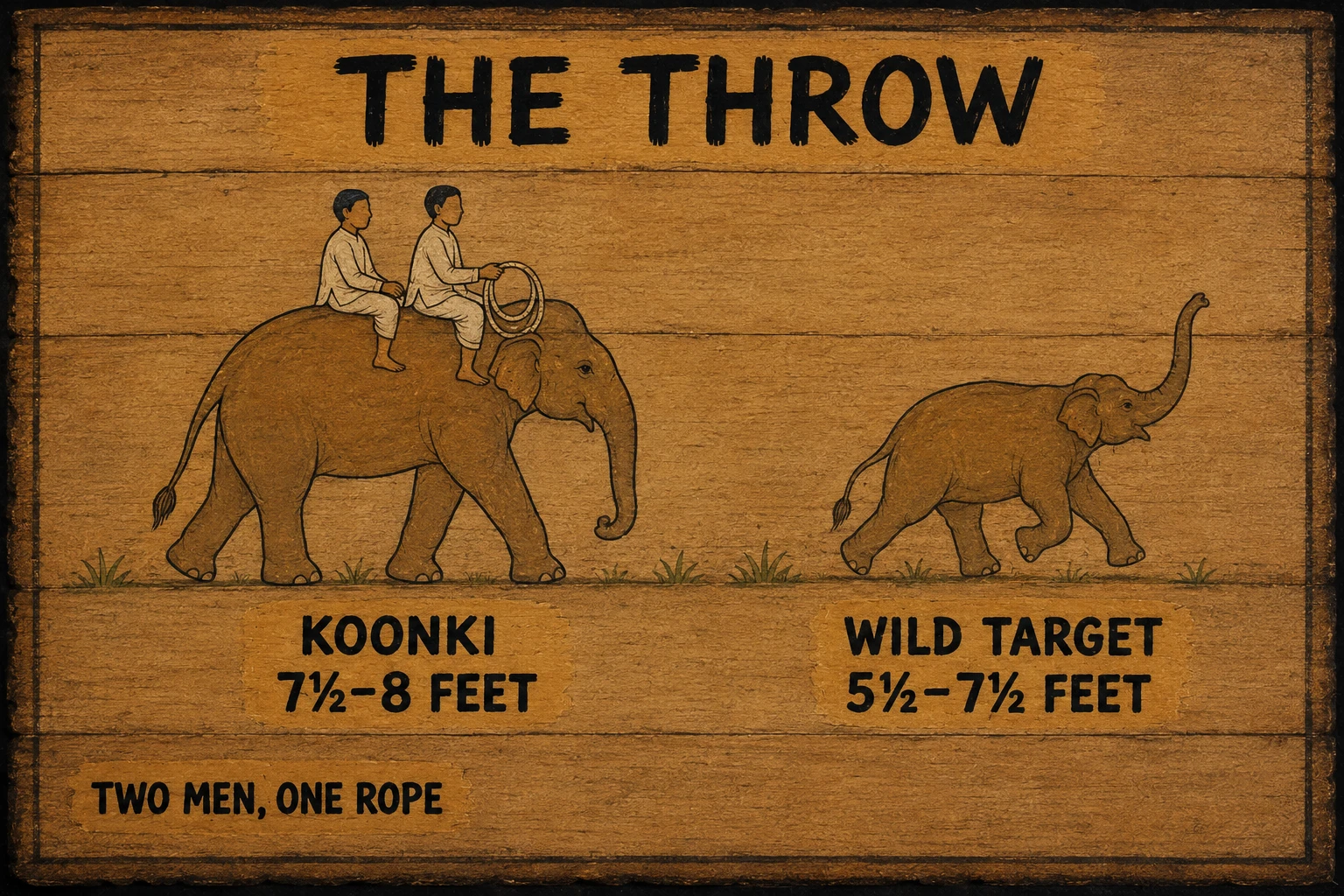
Mela shikar was the Assamese method of catching a fully wild adult elephant alive, without a trap, without a pit, without a stockade — on tamed elephants or koonkis. A rider mounted a koonki chased down a wild herd at a dead run through actual forest, picked out one target animal, and threw a rope noose over its neck while both animals were moving at speed, the wild one panicking, the trained one holding its nerve because it had been taught to. Two men did this together on the same koonki: a mahout steering from behind, and, just ahead of him, the phandi — the noose-man — who did the one thing in the entire operation that could not be taught by demonstration alone. You cannot practise throwing a rope around the neck of a bolting three-tonne animal. You either learn to do it by doing it, at real risk, or you never learn it at all. The word itself comes from phand — a noose — and a phandi was, quite literally, the man whose job was the noose.
This was not like a kheda drive. It was a trade — practised, taxed, licensed, passed from father to son and master to pupil across generations in Assam and the forests of North Bengal, until a law in the 1970s made it a crime.
The craft
Start with what the work actually was, because almost nobody who writes about phandis bothers to.
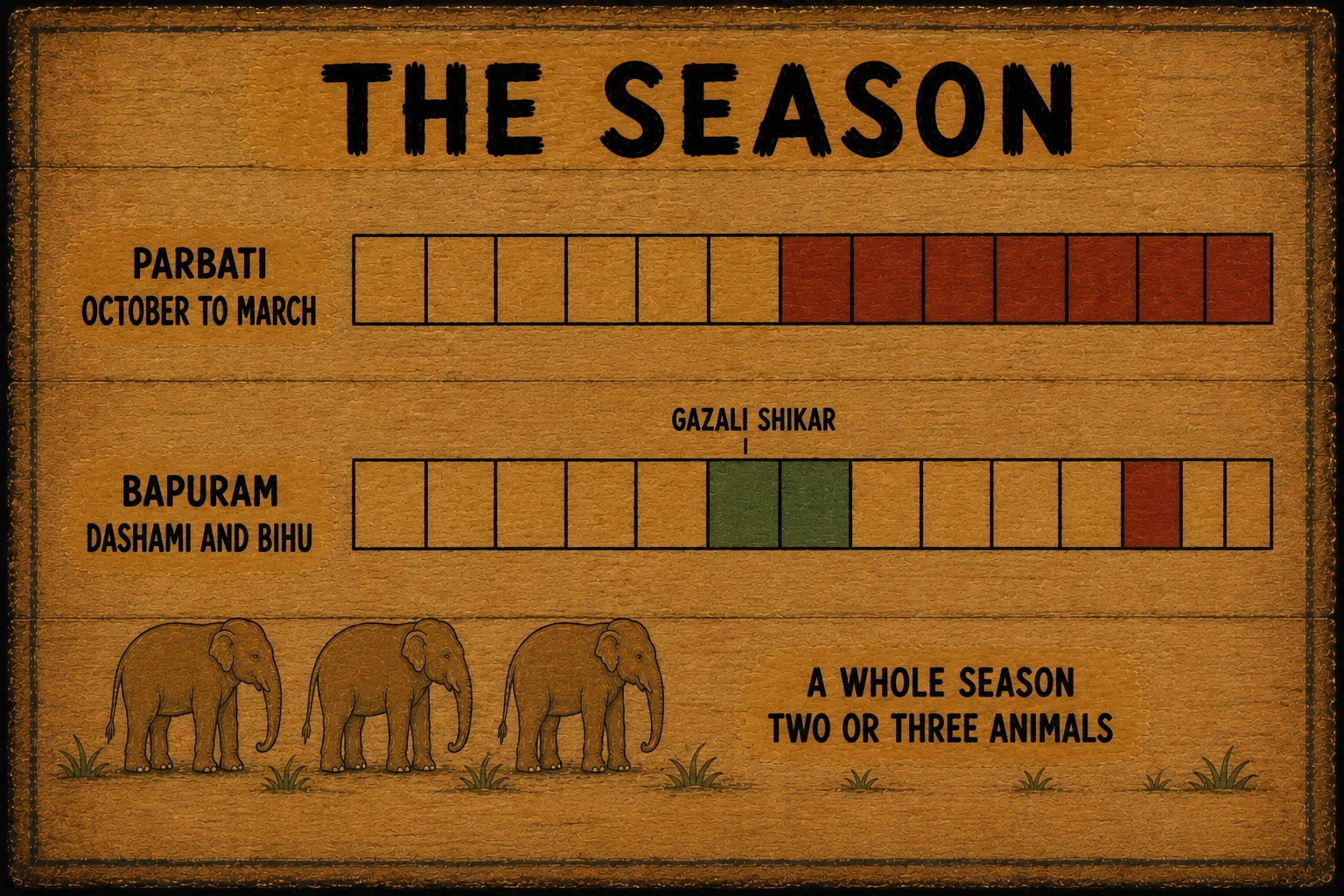
A mela shikar expedition did not go out for an afternoon. It went out for a season, and it went out heavy — six months of rice, dal, salt, oil, tobacco, medicine, all of it carried in on human and elephant backs, because that was roughly how long the work took from the morning a wild elephant was first noosed to the day it walked calmly enough among people to be brought home. The main season ran through the winter, October to March, though there was a second, smaller window too: gazali shikar, named for the tender young grass shoots — gazali — that sprout after the first pre-monsoon showers in May and June, which elephants cannot resist, and which drew them into open grassy patches where a phandi’s odds improved. Bapuram Shaikia remembered the calendar slightly differently — expeditions at Bijoya Dashami and again during Bihu in April — and I have decided not to smooth that difference away. Two people who did this work for a living do not agree, down to the month, on when the work happened. That is not a flaw in the record. It is what the record actually looks like when you get it from more than one person who was there.
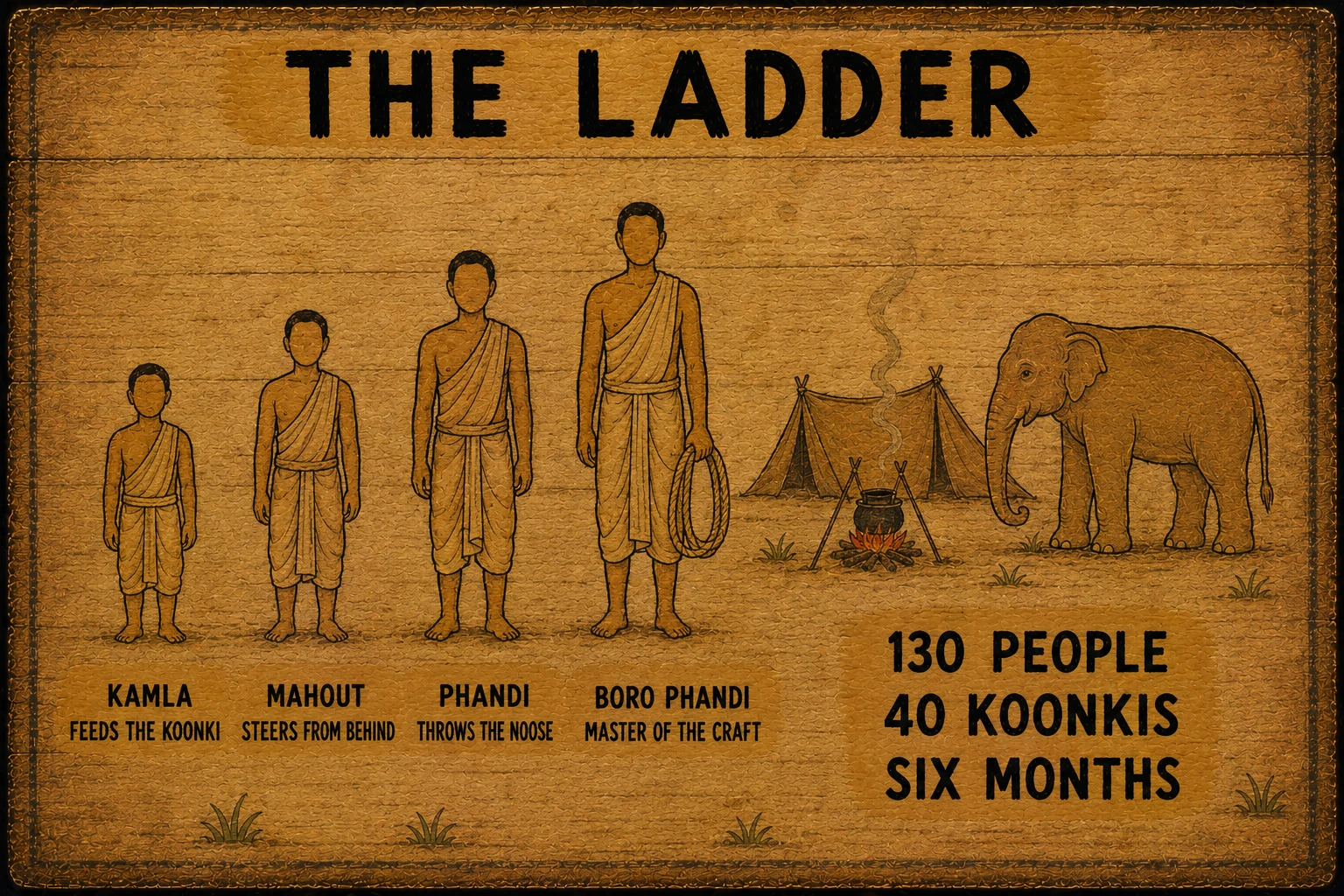
Whichever month it began in, the preparations started weeks earlier: ropes tested and retested, koonkis fed up to strength, provisions weighed out. A senior phandi, a handful of junior ones, mahouts, ghasis, and jogalis — general helpers — could add up to more than twenty people, sometimes many more; Chandreswar Gogoi remembered a party of over a hundred and thirty under Lalji’s own command at Kochugaon, with forty koonkis moving through the forest at once, a small army with drums instead of guns. A single standard team, by Parbati Barua’s own accounting, was much smaller — one koonki, one phandi, one mahout, and a kamla to feed and water the koonki back at camp — and a whole season’s work by one such team might land only two or three elephants, total. The forty-koonki camps were many teams working the same stretch of forest at once, not one team doing extraordinary volume.
The koonkis themselves were chosen with care for the terrain. In the dense, uneven forest of North-East India, smaller animals did the job better — seven and a half to eight feet at the shoulder, cows and tuskless makhnas preferred over the big tuskers, because they moved faster and quieter. Quiet mattered more than almost anything else. A koonki was drilled to answer silent foot-commands from its mahout and to move through undergrowth without so much as a snapped branch, because the entire method depended on getting close to a wild herd before the herd knew anyone was there.
For six months, that army simply lived in the jungle. There was no going home for a weekend, no supply run to a nearby town. Rain came and stayed. Leeches came and stayed. A rider on the bare back of a koonki, pushing through undergrowth after a fleeing herd, could be raked open by a low branch without ever seeing it coming, and everyone accepted this as the ordinary cost of the work rather than a story worth telling twice. Bringing a half-tamed elephant back to inhabited country too soon was, in Chandreswar’s word, dangerous — for the elephant, still capable of panic and violence, for the villages it might pass through, and for the men holding ropes attached to three or four tonnes of animal that had not yet decided to trust them.
The technique itself was precise in a way that rewards being written down properly, because most accounts skip straight to “they lassoed it,” which is like describing a surgery as “they cut him open.” A herd was located and then chased — not caught, chased, for as long as it took to tire the animals or drive them toward a hill or a river where their movement narrowed. One elephant, usually between five and a half and seven and a half feet at the shoulder, was picked out and separated from the rest. The phandi, riding in the front seat while the mahout controlled the koonki from behind him, waited for the target to lift its trunk — an elephant cannot see well straight ahead over its own trunk, and for a moment its head is exposed — and threw the noose over the neck in that instant. A second koonki closed in to help restrain it. Parbati Barua, writing in her own hand for a manual meant to train the next generation of mahouts, does not romanticise what could go wrong: the noose, tied incorrectly, could suffocate the animal it was meant to save. The phandi and the koonki working the noose, she wrote, faced considerable risk themselves, and cases of either being injured or killed were not uncommon. She was not speculating. She was describing a trade she had worked in since she was fourteen.

The rope itself was not one thing but several, each purpose-built: different weights and plies of jute for different jobs, the main noose typically a twelve-ply cord. Jute specifically, and not some stronger fibre, because — as Parbati put it in the same technical account — it caused only minor, easily curable injuries to the animal. Even at the moment of forcing a wild creature’s neck into a rope, the choice of rope was an argument about how much harm was acceptable, and jute was the answer that trade had settled on.
What happened after the capture is the part almost nobody records, because it isn’t dramatic in the way a chase is, and it is the part I find hardest to stop thinking about. The animal was dragged to a training depot — remaining there, by Parbati’s own account, three to four weeks before it could be handled by a single koonki instead of two, the resistance visibly, countably breaking down over those first eight or ten days — and handed to the difu phandis, the depot trappers, whose job was not to catch but to tame. “It’s a long process,” a former phandi named Chandreswar Gogoi told me once. “We had to torture and then console the animal by singing various songs. We also introduced it to various commands.” Torture and console, in that order, in the same sentence, without any sense that the two words sat oddly together — because for the men who did the work, they weren’t opposites. They were stages. Parbati’s own technical description confirms the same practice in more careful language: the animal was familiarised with human touch and voice through rituals of caressing and a recital of folk songs. What she wrote as procedure, in a manual, I watched happen once as a man’s whole body.
I know what those songs sounded like because I heard one, though not sung by a difu phandi in a depot camp. I heard it from Boro Phandi himself, that day in the Dullung forest, in the minutes after his tears finally stopped.
I had asked him, gently, to tell me about his years as bar phandi — the good years, before any of this. And something happened to him that I have not managed to see happen to anyone else, before or since. The crumpled, weeping face simply rearranged itself. The frail body, which a minute earlier had looked barely able to stand at the site of its own ruined home, found a kind of sway, a rhythm, the ghost of the motion a man makes on the back of a moving elephant. And he began, unprompted, to hum, and then to sing, low at first and then not low at all:
Allah Allah bolo re bhai haai Allah Rasul, Allaher bine keho nai haai Allah Rasul boro pandhi dharo re mai haai Allah Rasul bhal bhal dawai khelai re bhai haai Allah Rasul…
Say the name of Allah, brother. There is no one besides Allah. The great phandi has caught it. Now feed it well, brother. This was the song the difu phandis sang to a captured, terrified elephant in the days after it was brought in — Boro Phandi told me as much himself, once the song had run its course and his face had settled back into something like the present. He did not sing it for me. I do not think he even remembered, in that moment, that I was standing there with a notebook. He sang it the way a man hums the one prayer his hands still know after everything else has been taken from him — which, by the time I met him, was more or less the literal truth.
There was an older, harsher method too, sometimes called garh shikar and, in Parbati’s own more precise technical vocabulary, khedda — not one technique but two named variants, pung garh, built near a natural salt-lick, and dandi garh, built across a known migratory path — in which an entire herd was driven, over days, into a fenced stockade rather than singled out from horseback. It required far more labour and money than mela shikar, succeeded far less often, and could not be used on the biggest animals at all; it could only take elephants small enough to fit through the mouth of a trap built in advance. Mela shikar, precisely because it did not need a stockade, could go wherever the elephants actually were. That is, by Parbati’s own account, the real reason it became the dominant method in her part of the country, and khedda the exception.
The koonki, once it had done its work, taught its rider four commands, and even these do not survive in exactly one form. Parbati’s own technical account gives dhaat — stand still — agait — walk forward — pichhu — walk backward — and cheyi — turn. An earlier telling of this same craft, printed a few pages away from where this sentence now sits, gives three of the same words with a fourth substituted — boith, sit, in place of a turning command. I have decided not to resolve this either. A trade passed down entirely by apprenticeship, never written into a single authoritative primer until very late in its life, will always come down to us in more than one spelling and more than one final command. That is not sloppiness. It is what oral knowledge actually sounds like once you’ve heard it from two different mouths.
Lalji, and the brother who left
The senior man in most of these accounts is Prakritishchandra Barua, second son of Raja Prabhat Chandra Barua of Gauripur in western Assam, and known to every mahout, ghasi and phandi in his employ by one name: Lalji.
He was not, by the account of people who trained under him, a man who set much store by the traditional lore around which elephant was worth buying. That lore was extensive and specific. A good elephant was sambalpith — broad and flat across the back, so that a load did not concentrate its pressure in one spot and rub the animal raw; pankhidum — a small tail, bird-like; gyarakhal — thick, granular skin, closer to a rhinoceros’s, less prone to chafing under the ropes. And there were elephants to be avoided on sight: solakhi, with sixteen toenails instead of the usual eighteen — a bad sign, though more nails than eighteen was fine — and jharudum, a tail so long it swept the ground like a broom, said to sweep misfortune into the house behind it. Folklore attributed this knowledge, only half-seriously, to Nakul and Sahadev of the Mahabharata, though the twins are remembered mainly as authorities on horses and cattle, not elephants, which makes the attribution feel more like a way of saying this knowledge is old than a literal genealogy.
Lalji ignored most of it. He caught, bought, and sold elephants by the hundred across a working lifetime, and the people who came after him — the phandis, the mahouts, the elephant experts of the next two generations — call him guru without irony. No serious account of the Indian elephant, one online exchange about him put it plainly, gets written without his name in it.
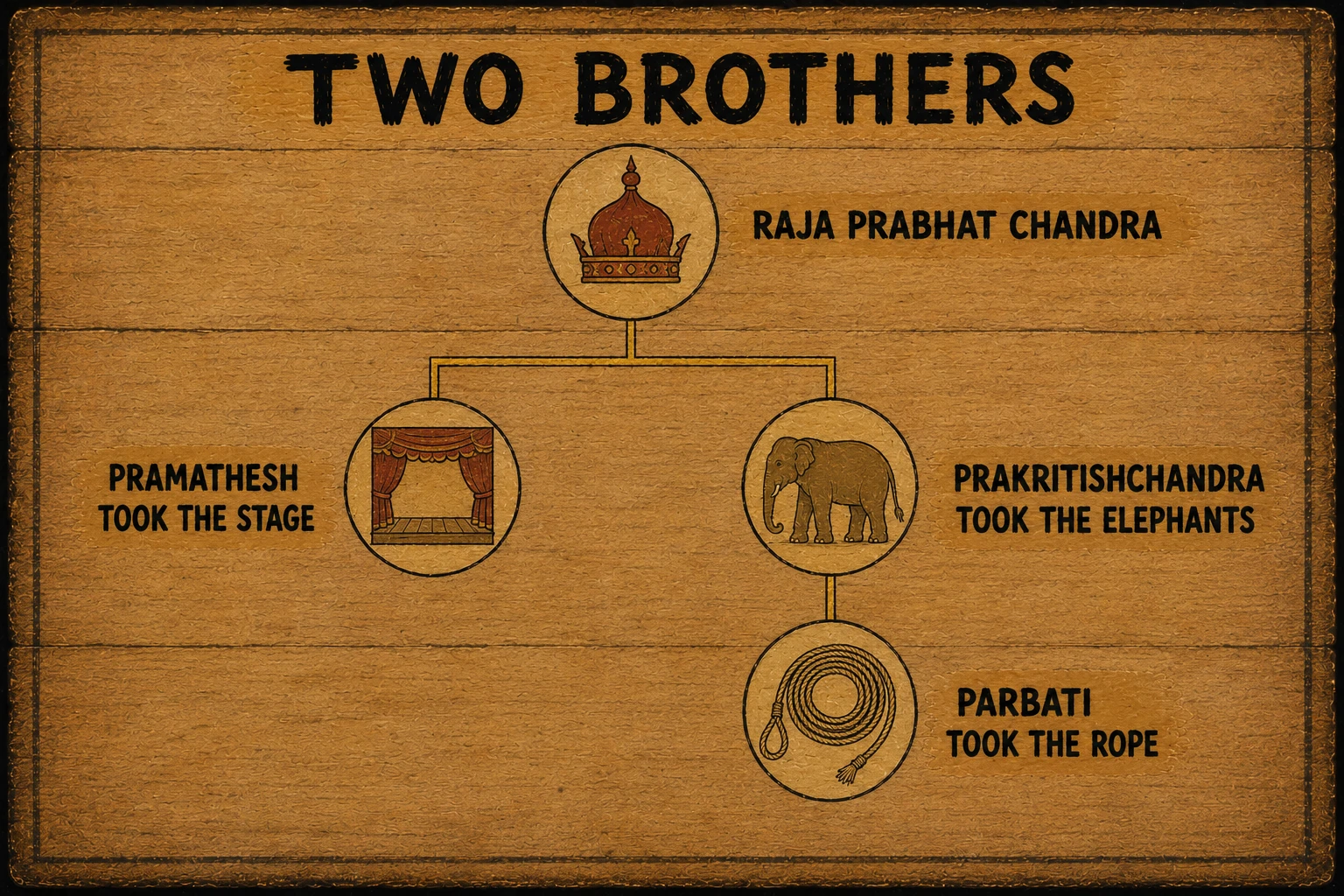
His elder brother had left the family business entirely, and for reasons that had nothing to do with elephants. Pramathesh Barua, Raja Prabhat Chandra’s eldest son, was expected to inherit the Gauripur zamindari. He had no interest in it. He wanted theatre, then film — he went on to direct and star in Devdas, first in Bengali and then, remade for a Hindi audience two years later with K.L. Saigal in the lead, in the version that made him a household name across the whole country and earned him the epithet “Devdas Barua.” He asked his father to hand the estate to his younger brother instead. Prakritishchandra — Lalji — took it, and with it the elephants, and became, by the considered judgement of everyone who has written on the subject since, the single most important private figure in the recent history of Indian elephant capture.
His daughter Parbati grew up in that household, among more than forty domesticated elephants, and inside a world that treated the whole enterprise as a samaj — a society, with its own hierarchy, its own etiquette, its own way of conferring status.
What Parbati actually said
Most of what circulates about Parbati Barua now comes filtered through the fact of her Padma Shri, which makes her sound, understandably, like a monument. It is worth going back to what she actually said, in her own words, at length, before the honours arrived — and worth saying plainly whose notebook those words first landed in.
The interview belongs to Naresh Mitra, my colleague at this newspaper, who travelled to Guwahati in 2010 to sit with Parbati Barua at her home — a house called Prakriti, on Pub Sarania — and came back with far more than the paper ever ran. Naresh died a few years ago, in an accident, and he is not here to see any of it used properly, which is as good a reason as any to use it properly now. He opened his own account of that afternoon by noting, with the dry precision he brought to most things, that the thinly built woman in front of him belied the fact of having trapped no fewer than fourteen wild elephants across four decades in the forests of the Northeast and North Bengal. That sentence is his, not mine, and it is better than anything I could write to introduce her now.
Her first capture, she said, was at Kochugaon forest, in what was then undivided Goalpara district, in the late 1960s, when she was fourteen years old. The camp that season ran to more than a hundred and thirty people and forty koonkis, under Lalji’s command. Five koonkis went out on the actual attempt; on each rode a phandi and a mahout, including her, a teenage girl on the back of a moving elephant in pursuit of a wild herd, in country where the undergrowth alone could take an eye out if you weren’t careful. Her father did not accompany her on that particular run — and, she noted, the mahouts and phandis around her were unusually careful with her precisely because of who her absence-of-father made her: not a child along for the experience, but their employer’s daughter, effectively their employer, riding into forest where a mistake killed people. She noosed a female elephant, five feet nine inches at the shoulder — she remembered the exact measurement more than fifty years later, the way you remember the size of a thing that could have killed you.
She was afraid, and said so plainly, without the performance of fearlessness that public retellings of her life often supply for her. Before the party even left the camp that morning, there was a formal farewell — Bidai — the kind given to someone setting out on a journey they might not return from, embraces and blessings exchanged in the grey early light with the smell of woodsmoke and wet canvas still hanging over the camp. “The job is a risky one,” she told Naresh. “Anyone can die while trapping elephant. So, when we set out to trap elephant we take Bidai. You need a lot of controlling power. So, fear is obvious to crop in.”
Her last capture, by her own account, was in 1978, near Madarihat in North Bengal — not for sport or profit, but because the animal was a sick, abandoned calf that needed to be brought in for treatment. It is a detail worth sitting with: the very last act of mela shikar in her working life, right at the edge of the era when the practice was ending everywhere else, was an act of rescue rather than capture in the old commercial sense.
What she mourned, more than the loss of the hunt itself, was the loss of the samaj around it. “It’s a unique Guru-Shishya parampara art form,” she said. “Elephant trapping is a big samaj of phandis, mahouts, ghasis and many others. I remember the status and respect a phandi could get during the heydays of mela shikar. Nowadays, mahouts mostly do not get that opportunity to live and learn by staying within that samaj.” A trade is not only a set of techniques. It is also the social world built around passing those techniques on — the rank, the deference, the years of watching before you were permitted to do — and it is possible for a government to leave the techniques intact, in books, on paper, in a handful of surviving practitioners, while the samaj that gave those techniques their meaning quietly disappears anyway.
The stable she inherited from Lalji had numbered more than forty animals; by the mid-1970s it had fallen to about thirty-two, partly for want of the manpower it took to run something that size. She could still, decades later, list them like family, because they were: the tuskers Pratap Singh — her father’s favourite — Man Singh, Rudra Singh, Kirot Singh; the females Kanan Bala, Kadam Piyari, Monomaya, Sunmaya, and Lakhi; the tuskless males William, Sikandar, and Kumar.
Boro Phandi
The man I started writing about, all those years ago, was not from that world of royal stables and named elephants. He was eighty-five years old when I found him, and his name — his working name, the one that had replaced whatever he was christened — was Boro Phandi.
He had trapped and trained close to a hundred elephants across his working life, before capture was restricted after 1972 and banned outright in the early 1980s. He lived, by then, in the Dullung reserve forest, in one of thirteen villages that had grown up on its fringes — settlements of roughly a thousand phandi, ghasi, and other elephant-trade families, near the Assam–Arunachal Pradesh border, people whose profession had simply ceased to exist under them and who had nowhere obvious to go and no other trade to fall back on.
In 2006 the forest department burned the villages down.
The families had gone to court and won a status quo order. It did not stop what happened next. Officials arrived, beat people, and set the huts alight anyway. The families fled and, having nowhere else to go, drifted back. The huts were rebuilt and burned again. A boundary dispute between Assam and Arunachal Pradesh compounded the cruelty with bureaucratic absurdity: officials from both states, each claiming the land was the other’s responsibility, took turns evicting the same people. It happened five times in total before the villages were abandoned for good, and by the time I stood there, years later, the jungle had already grown back over the ash — vines and saplings reclaiming ground with the patient, indifferent speed forests use to reclaim anything.
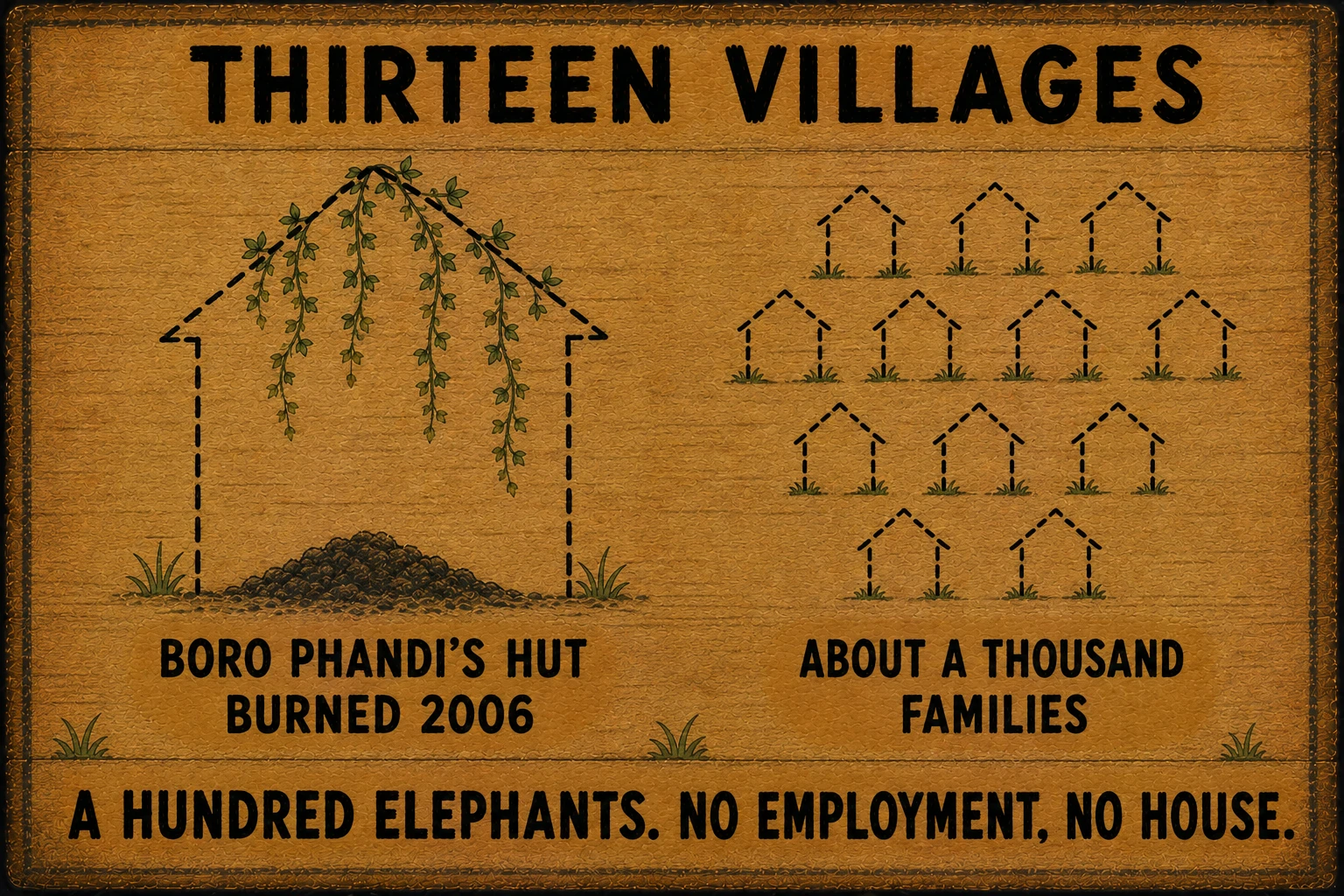
Boro Phandi cried when he talked about it. He had no house of his own left. He was living, at eighty-five, in a temple in Gogamukh — a small town in Dhemaji district — because he and his wife could not both stay inside the mandir at once, so she lived separately, nearby. “Is this the day I have to wait for at this old age?” he asked.
He was not a solitary case. According to the Sadou Asom Hati Phando Sanmilan Union — the phandis’ own organisation, formed to press for their rehabilitation — the government had, in the decades since the ban, found employment for only thirty-seven of the more than a thousand people the ban had displaced. A few had received land and money in Lakhimpur district. The union’s assistant secretary called it too little, and far too late. The forest department, for its part, did not deny the scale of the problem — a principal chief conservator told me, on the record, that rehabilitation was a matter of social responsibility, but that the issue was complicated, and that nothing could be decided at that moment. The district administration said the process was still on.
Not everyone even agreed rehabilitation was warranted. A veterinarian and elephant expert I spoke to at the time pushed back on the premise itself: elephant trapping, he pointed out, had always been seasonal work; the rest of the year, phandi families had farmed, like everyone else in their villages; so the idea that the ban had stripped away their sole livelihood was, in his view, overstated. It is a fair point, argued in good faith, and it sits uneasily next to Boro Phandi crying in a burned clearing, and I have never worked out how to hold both of those things in my head at once without one of them going quiet.
Parbati Barua, when Naresh put the question of revival to her, answered without hedging, and without romance either. “If nothing is done now, the art of mela shikar is sure to die soon,” she told him. It was not, for her, a small thing to watch happen. She had learned the craft at fourteen from her own father, grown up among elephants, mahouts and phandis, and it showed in how she talked about it — the loss of the art was, by her own word, the most painful thing she could imagine.
By the time they spoke, Assam’s environment and forest minister, Rockybul Hussain, had already written to New Delhi asking that mela shikar be revived. Parbati was careful, in Naresh’s notes, about what she wanted that revival to look like. “I do not know whether it will be allowed once again,” she said. “But I do not see any harm if mela shikar is occasionally allowed. That will provide livelihood to hundreds of phandis and keep the man-elephant conflicts in control.” She was quick to close off the obvious misreading of that sentence — that she was asking for the old free-for-all back. A relaxation of the ban, she said, did not mean phandis should be allowed to trap elephants without limit. If mela shikar came back at all, it should be run under the strict watch of an expert group, whose whole job would be making sure the art was never misused again. She was not asking Delhi to look away. She was asking it to look, carefully, and then let a small number of very specific people keep doing the one thing they had spent their lives learning to do. The last Naresh heard, no decision had been taken.
What I think this actually is
I am wary of tidy theories, but I have turned this story over enough times now to have arrived at something close to one, and I would rather state it plainly than dress it up.
A state does not usually destroy a hereditary trade out of malice. It destroys it, or lets it wither, because the trade’s usefulness to the state and the trade’s meaning to the people who practise it were never quite the same thing, and once the two come apart, the state has no particular reason to keep tending the second. The Government of Assam wanted, reasonably enough, fewer wild elephants captured and fewer elephants dying in the process. It got that. What it did not budget for, because it was never really its problem to budget for, was the samaj — the guru-shishya lineage, the status of a phandi returning from the forest, the thousand families whose entire social position rested on a skill the state had just declared it no longer needed performed. The elephants, on the whole, are probably better off. The people are a harder question, and thirty-seven jobs against more than a thousand displaced families is not really an answer to it, just a number standing in for one.
Palakapya, if he existed, is said to have found King Romapada’s captured elephants wounded and frightened in the royal stables and told the king what capture and care actually required. Nobody, in that old story, asks what happened to the trapper.
Coda
I have a copy of the book on my shelf. Hatir Songe Ponchash Bochor — Fifty Years With Elephants — Prakritishchandra Barua’s own account of a lifetime in the forest with his animals, set down by Panchugopal Bhattacharya, who transcribed the old Raja’s telling and appended his own closing thoughts at the end. Parbati Barua put it in my hands herself, at her home in Guwahati — the house Naresh had already described so precisely in his own notes, on Pub Sarania, called Prakriti. Very little of what Naresh found there ever made it into print. A few hundred words ran, eventually, on an inside page, mostly about the mechanics of the noose and the camp. Her stable’s elephants by name, her account of her own fear before her first capture, her father’s disregard for the old superstitions, the samaj she mourned more than the hunting itself — all of it sat in his notebook, and then in an email he sent years ago, for 16 years, the same 16 years the unfinished essay about Boro Phandi sat waiting for me to go back and cry with him properly instead of stopping the sentence where I stopped it.
Naresh Mitra died a few years ago, in an accident. He is not here to see any of this finally used the way it deserved to be used the first time. Whatever is good in the Parbati Barua sections of this essay is his work, sixteen years late in finding a reader.
I still have not properly reread the book she gave me. Writing this, finally, is the reason I took it down from the shelf.
This piece draws on original reporting and interviews conducted by Naresh Mitra and the author with Parbati Barua, Chandreswar Gogoi, and phandi and forest department sources in Assam, along with published material on the Gauripur Barua family, Pramathesh Barua, and the Wildlife (Protection) Act, 1972.