Why the Government Loves Millets But Won't Buy Them
Millets carry a higher support price than paddy. What they do not carry is a buyer — and that is not an oversight.
Achintyarup Ray ·
Start with three numbers.
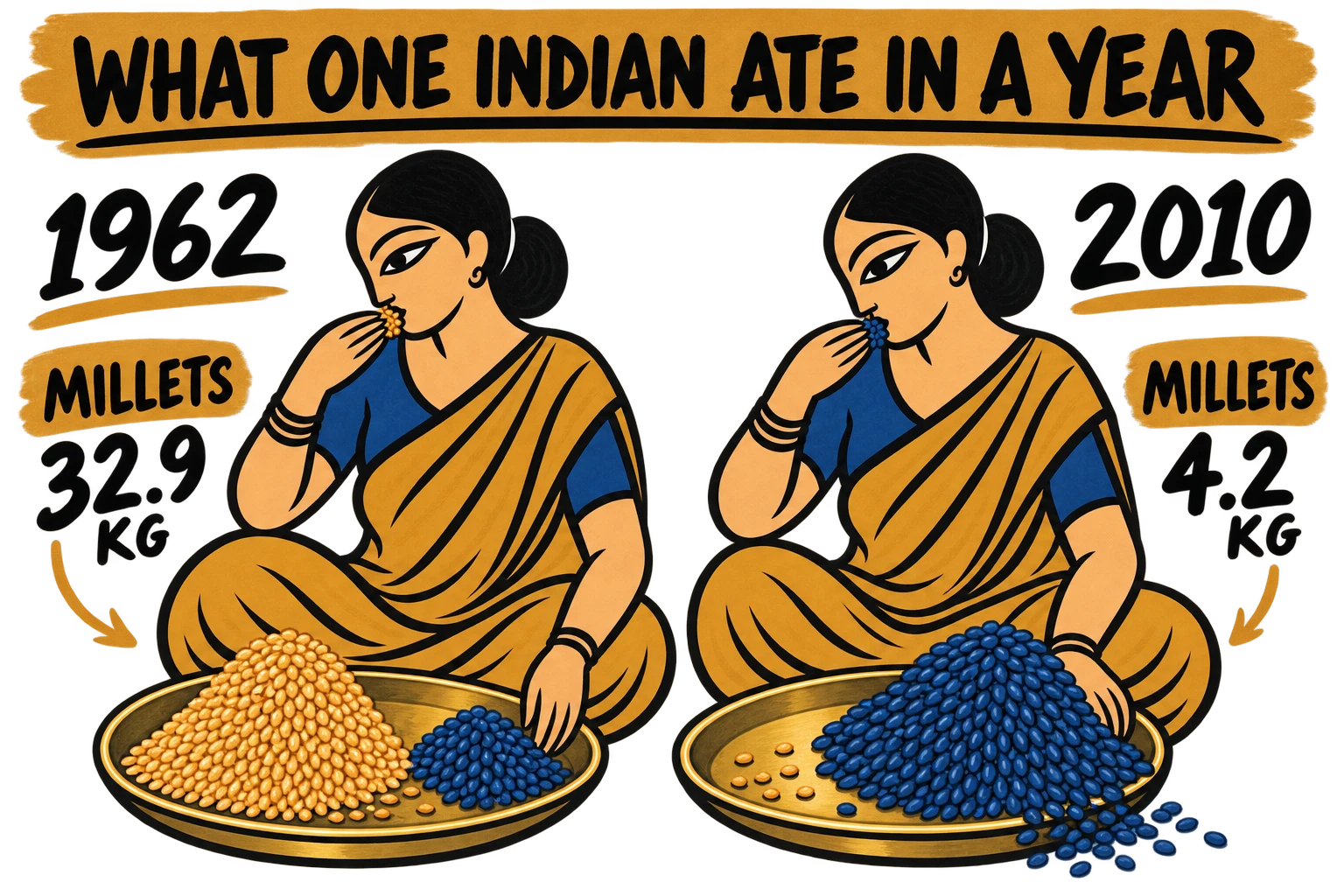
One. Your grandparents ate nearly eight times more millet than you do. In 1962 the average Indian ate 32.9 kg of millets a year. By 2010 it was 4.2 kg. Over the same period wheat consumption almost doubled, from 27 kg to 52 kg.
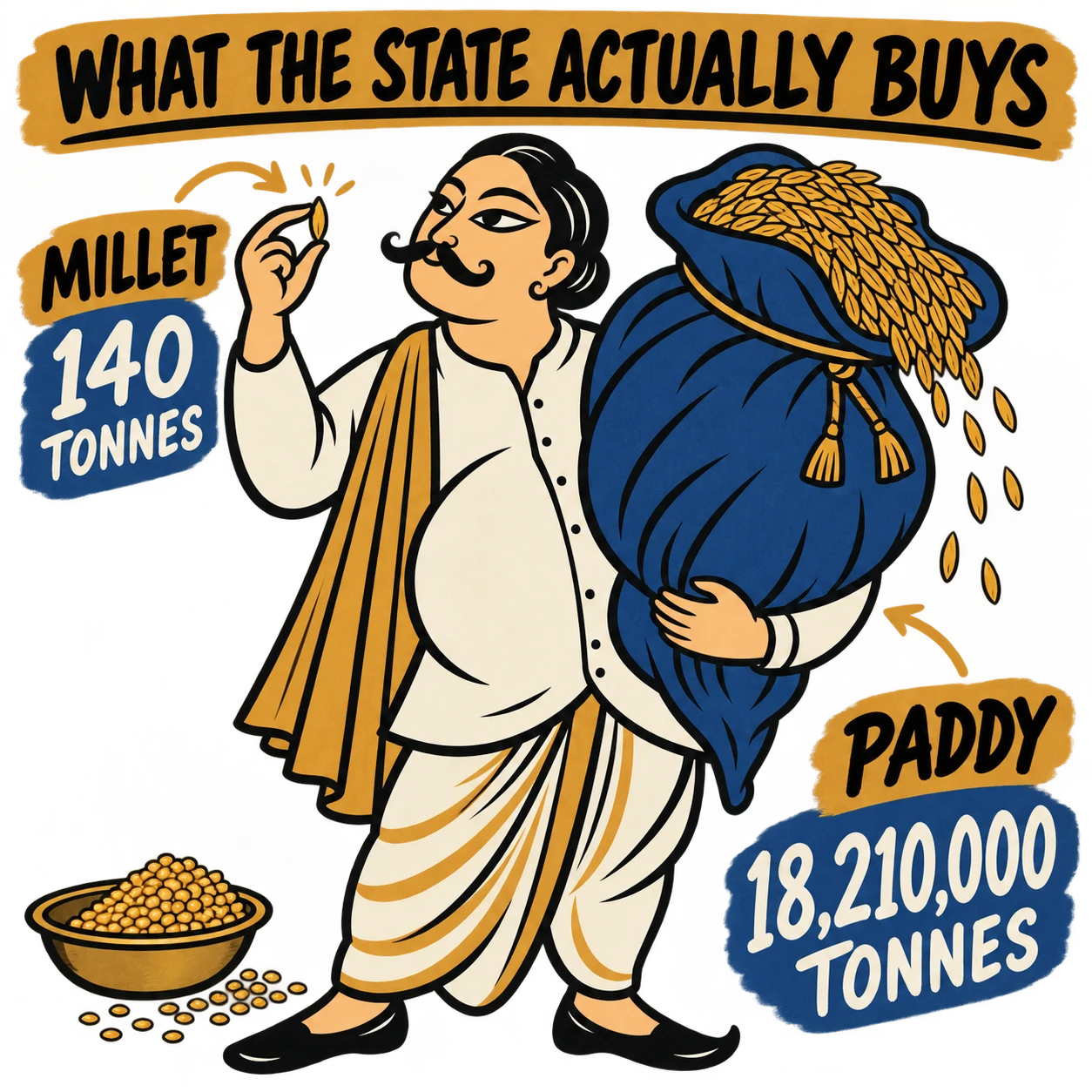
Two. Picture a goods train. In 2022-23 the government bought 18.21 million tonnes of paddy from Punjab. From the same state, in the same year, it bought somewhere between nothing and 140 tonnes of bajra and jowar. The paddy would fill more than seven thousand goods wagons. The millet would not fill one.
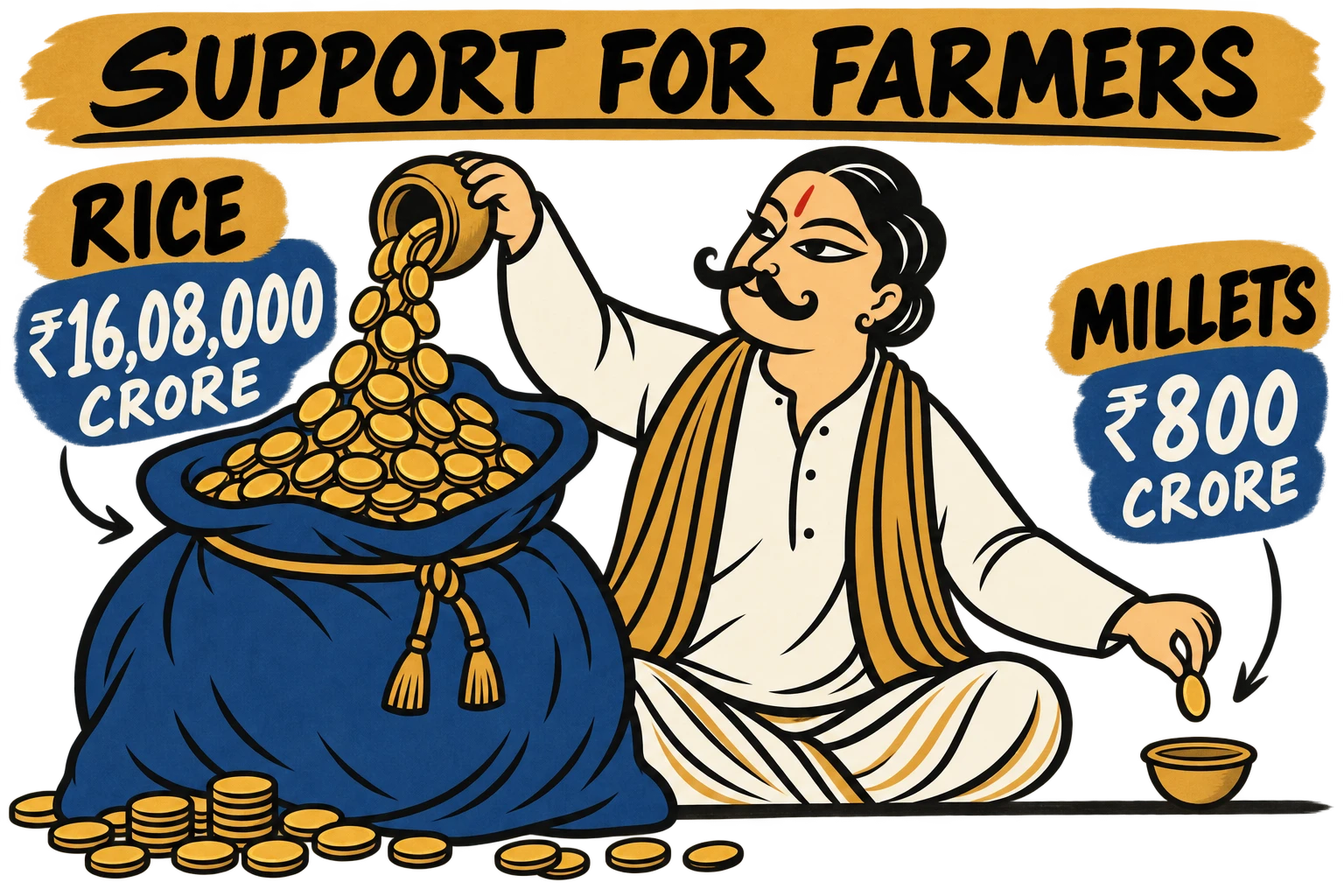
Three. Over the last decade the government paid paddy farmers ₹16.08 lakh crore in support prices. Its flagship scheme to promote millet-based food products is worth ₹800 crore, spread across five years. That is roughly one rupee for millets for every two thousand rupees for rice.
Now hold those three numbers next to the last three years of speeches — the International Year of Millets, Shree Anna, millets on the G20 dinner menu, the Prime Minister calling ragi a superfood.
The gap between the two is not an accident. It is the design. And once you see why, a great deal of Indian food policy makes sense.
First, how millets left the fields
Until about sixty years ago millets were ordinary food across much of India. Ragi, jowar, bajra, kodo, marua, cheena — every region had its own. They grew without irrigation, survived bad rain, and needed almost nothing but labour.
Then came the near-famines of the 1960s and the Green Revolution. India decided, deliberately, to grow its way out of hunger using two crops. New seeds, canal water, cheap fertiliser, subsidised power for tubewells — all of it went to rice and wheat.
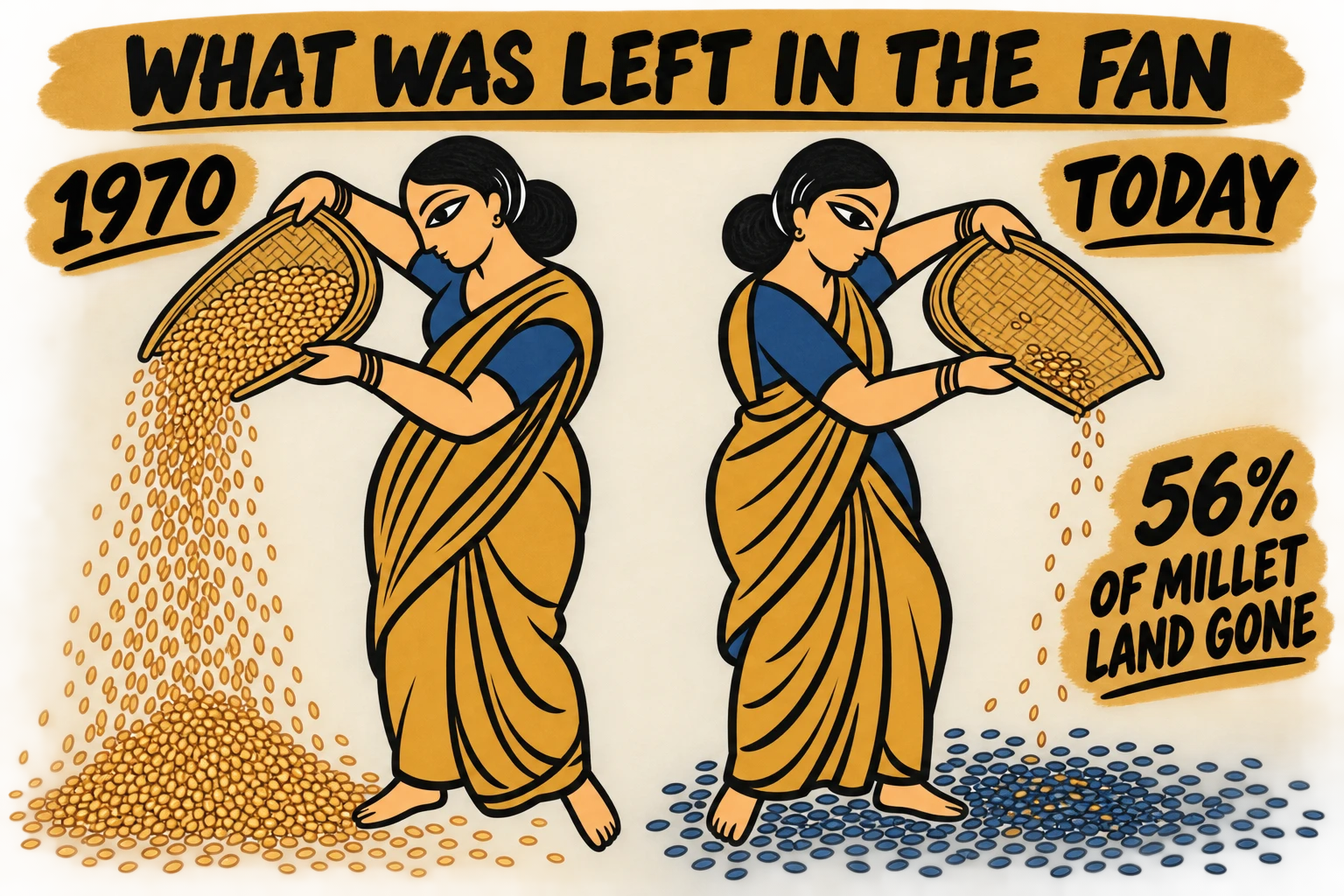
It worked. India stopped importing food. But millets were pushed off the land. Over five decades India lost about 56 per cent of the area under millet cultivation, and the area under sorghum alone fell by more than 85 per cent.
Farmers did not change their minds. A system changed them.
The machinery nobody explains
Every year the government announces a Minimum Support Price — a floor price — for a list of crops. For most of that list it is a number on paper. For rice and wheat it is real, because the Food Corporation of India actually turns up and buys the harvest, in enormous quantity, to feed a ration system now covering around 79 crore people.
The scale is hard to picture until you see it written down. In the 2025-26 wheat season the government bought 256 lakh tonnes by the end of April alone, paying 21 lakh farmers ₹62,156 crore. In a recent paddy season, purchases crossed 700 lakh tonnes and over 96 lakh farmers were paid ₹1,45,845 crore.
Against that, the millet column. For the 2025-26 rabi season the Centre estimated states would buy about 7.79 lakh tonnes of coarse grains including millets — around one per cent of the paddy figure.
The prices are not the problem. For 2025-26, ragi’s support price is ₹4,886 a quintal and jowar’s ₹3,699, both well above paddy’s ₹2,369. Ragi even received the second-largest price increase of any kharif crop that year. But a support price with no buyer behind it is only a suggestion. A Punjab farmer knows his paddy is sold before he sows. A ragi farmer in Koraput mostly does not.
What the millet campaign actually bought
Branding and processing, not purchase.
The exports show it. India shipped about 1,46,300 tonnes of millets worth $70.89 million in 2023-24. In the year straight after the millet year, that fell to 89,165 tonnes worth $37 million, before partly recovering to 1,38,690 tonnes worth ₹543 crore in 2025-26. On national production of about 18.6 million tonnes, exports remain under one per cent. This was never a trade story.
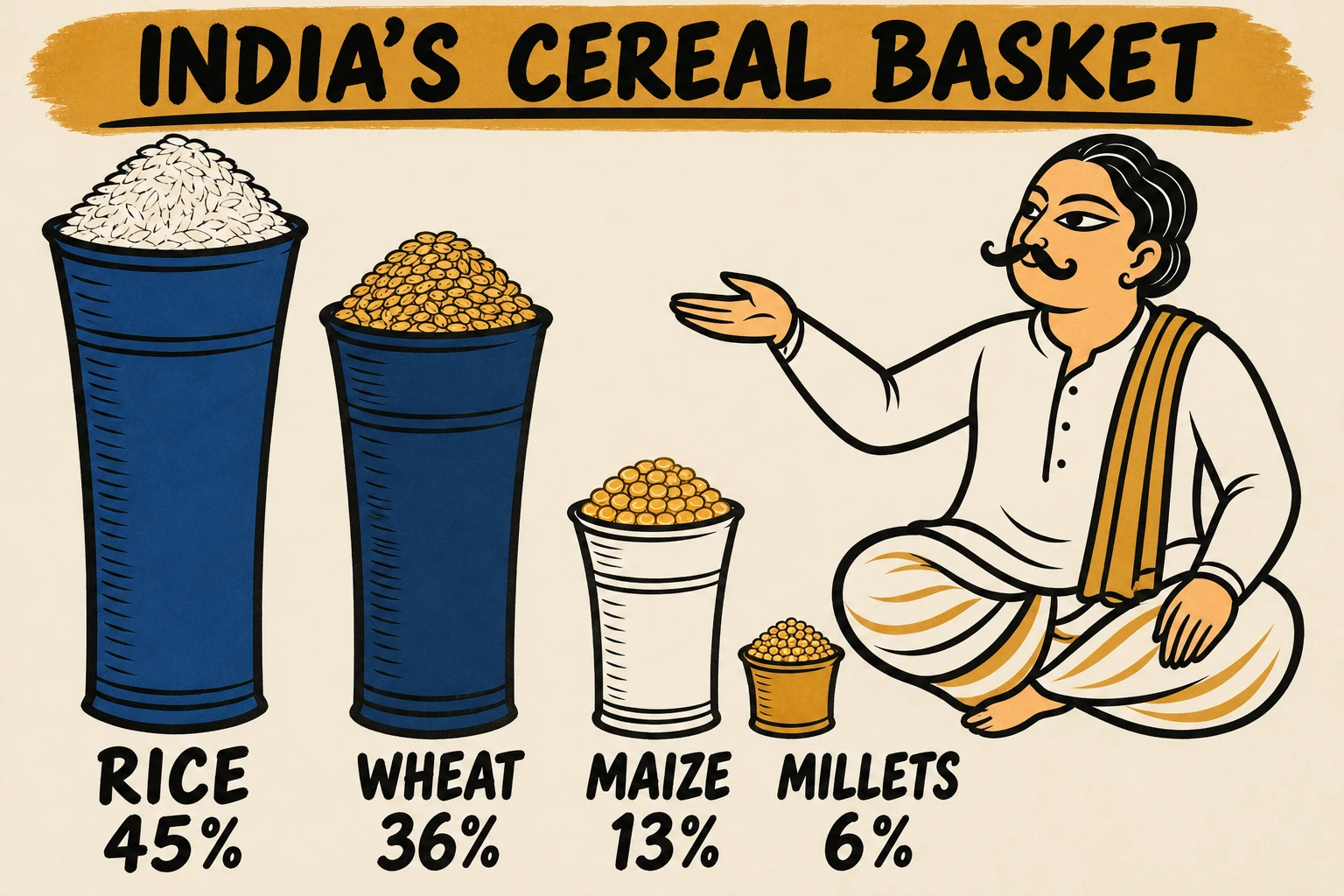
And in the food system as a whole millets stayed marginal.
The real reason
Everyone in Delhi knows the rice-wheat system is straining. On 27 January 2026 the godowns held 33.15 million tonnes of rice and 26.10 million tonnes of wheat, against a combined buffer requirement of 21.41 million tonnes — nearly three times what the rules ask for. The food subsidy bill for 2026-27 is expected to reach about ₹2.5 lakh crore, above the budgeted ₹2.28 lakh crore.
Everyone also knows what happens if you touch it. In 2020 the government tried to change farm marketing law and got a year-long siege of Delhi and a full retreat.
The purchase system is no longer only a food programme. It is a political arrangement — a guaranteed cheque binding an organised, well-connected body of farmers to the state. It cannot be dismantled cheaply.
Millets solve the presentational half of that problem. Promote them loudly, buy almost none, and you get the look of correcting the Green Revolution’s excesses without disturbing anyone capable of making trouble.
And who grows millets?
Mostly people on dry, unirrigated land. Many are adivasi. Their holdings are small and scattered — Rajasthan, Maharashtra and Karnataka together account for over half of national output, but within those states the crop sits in the poorest, driest talukas. These farmers have never had a union that could block a national highway.
Indian farm policy has always followed political strength rather than agronomic sense. Millets left the food system in the 1960s for the same reason they cannot easily be legislated back now.
And the grain has returned — as expensive city food. Per capita consumption has crept up from 2.1 kg a year in 2015 to about 3.3 kg in 2023, largely on state schemes and urban demand. The poor lost it as a staple; the middle class regained it as wellness. The margin now belongs to whoever mills and packages it.
Two fairness notes
The first: none of this is one government’s invention. The decision that displaced millets was taken sixty years ago by a different dispensation, and the hunger was real. What belongs to the present is narrower — taking credit for the reversal without paying for it.
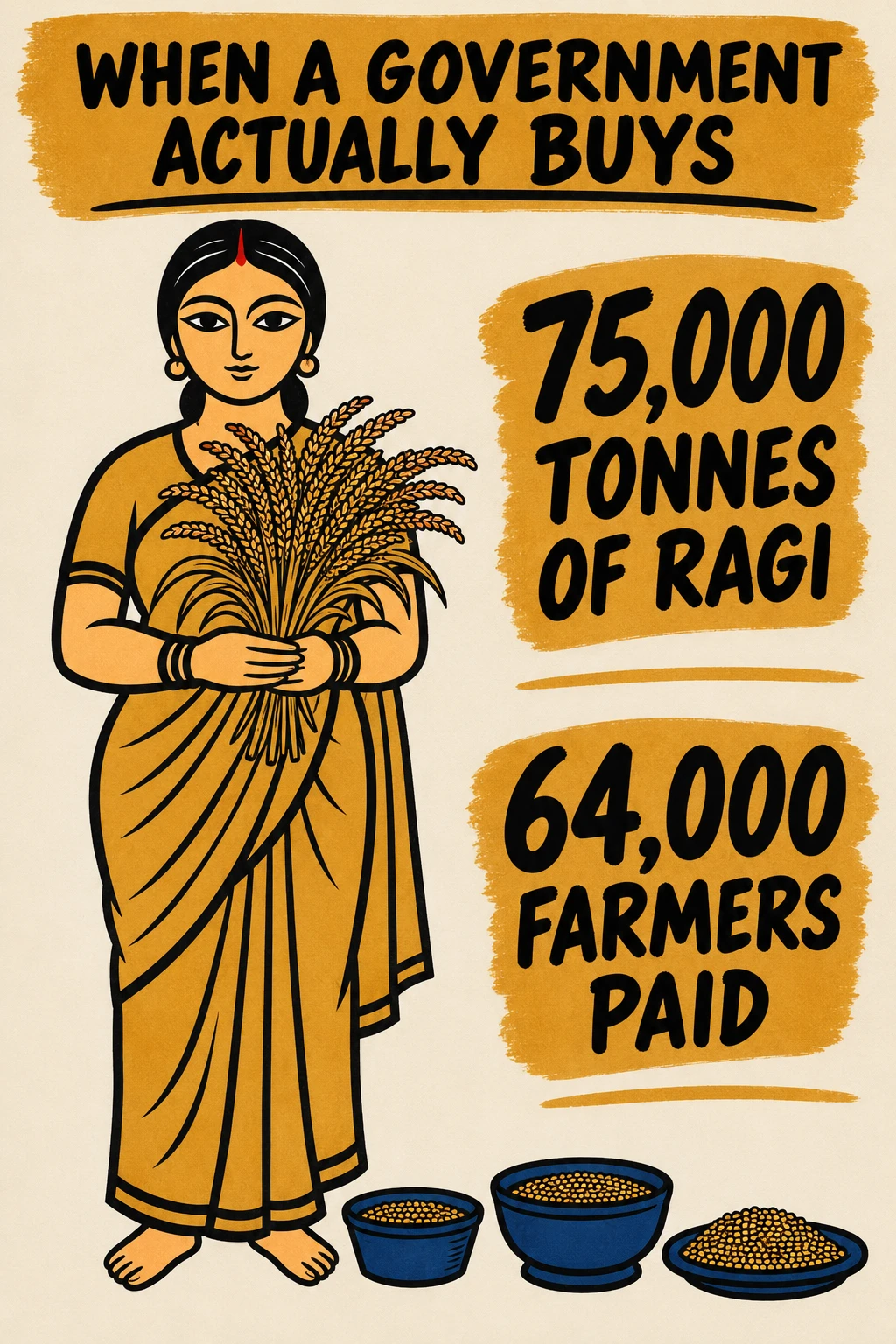
The second: parts of it are working. In 2024-25 Odisha procured 75,000 tonnes of ragi from more than 64,000 farmers, and the FCI began its first-ever ragi purchase from the state, targeting 40,000 tonnes for the central pool. That is a genuine first — and, set beside 700 lakh tonnes of paddy, still a rounding error.
What works, where it has been tried
The Odisha Millets Mission began in 2017 in 30 blocks across 7 districts and had reached 143 blocks across 19 districts by 2022. It bought 6.39 lakh quintals of ragi between 2018-19 and 2021-22 and transferred ₹209.94 crore straight to farmers, while setting up over a thousand threshing and processing units and 169 community seed centres. The ragi goes into ration shops, anganwadis and school meals — guaranteed demand at the far end.
Buy the grain reliably. Put it into welfare schemes. Fund seed banks and village dehulling machines, because a grain nobody can process is a grain nobody will grow. It costs money, and nobody makes a speech about a dehulling machine.
From this side of the country
We in Bengal read all this as somebody else’s story — a Deccan story, a Rajasthan story.
It isn’t. Marua and its cousins grew across the red laterite uplands of Purulia, Bankura and Jhargram, and were eaten in Santhal households within living memory. Trials in Bankura have found ragi returning ₹1.28 for every rupee invested, on land that was otherwise lying barren. Most of the revival work here is being done by NGOs — notably the Switch On Foundation, working with women farmers in Bankura and Purulia — and not by the state. West Bengal has no millet mission worth the name.
The people who still know how to grow and cook these grains here are old. Whatever is not recorded in the next ten years will be gone. That, in the end, is what the argument over millets is really about: not a superfood, but a body of knowledge no advertising campaign can bring back once it is lost.
Sources
Consumption: Basavaraj et al. / IndiaSpend, cited in Frontiers in Sustainable Food Systems, 2021; NSSO Consumer Expenditure Surveys, Rounds 68–77.
Procurement and MSP: PIB and Cabinet Committee on Economic Affairs releases on Kharif MSP, marketing seasons 2025-26 and 2026-27; Ministry of Consumer Affairs, Food and Public Distribution; Punjab and Haryana offtake figures as reported in The Wire, February 2026.
Area and production: Observer Research Foundation, cited in Mongabay India, March 2025; Department of Agriculture and Farmers’ Welfare via APEDA.
Stocks and subsidy: FCI stock position, January 2026; Business Standard, June 2026.
Exports: APEDA, “Indian Millets”; PIB, “Empowering India through Millets,” August 2025.
Odisha: Government of Odisha, Department of Agriculture and Farmers’ Empowerment; TDCC Odisha; FCI, August 2025.
West Bengal: Switch On Foundation, “Pilot Project Report on Economic Viability of Millet Cultivation in Bankura District, West Bengal,” 2024.