Rathindranath, Janaganamana and copyright
The song was adopted in January 1950. More than a year later the Republic still had no legal right to press it onto a record — because Rabindranath's son had sent the agreement back with changes.
Achintyarup Ray ·
Soon after Jana Gana Mana was adopted as the national anthem, the copyright in the song had to be transferred from Visva-Bharati to the Government of India. The process was far from smooth. More than a year after the Constituent Assembly adopted the song, the transfer was still unfinished — because Rabindranath Tagore’s son Rathindranath would not sign the agreement Delhi put in front of him. He sent it back with changes.
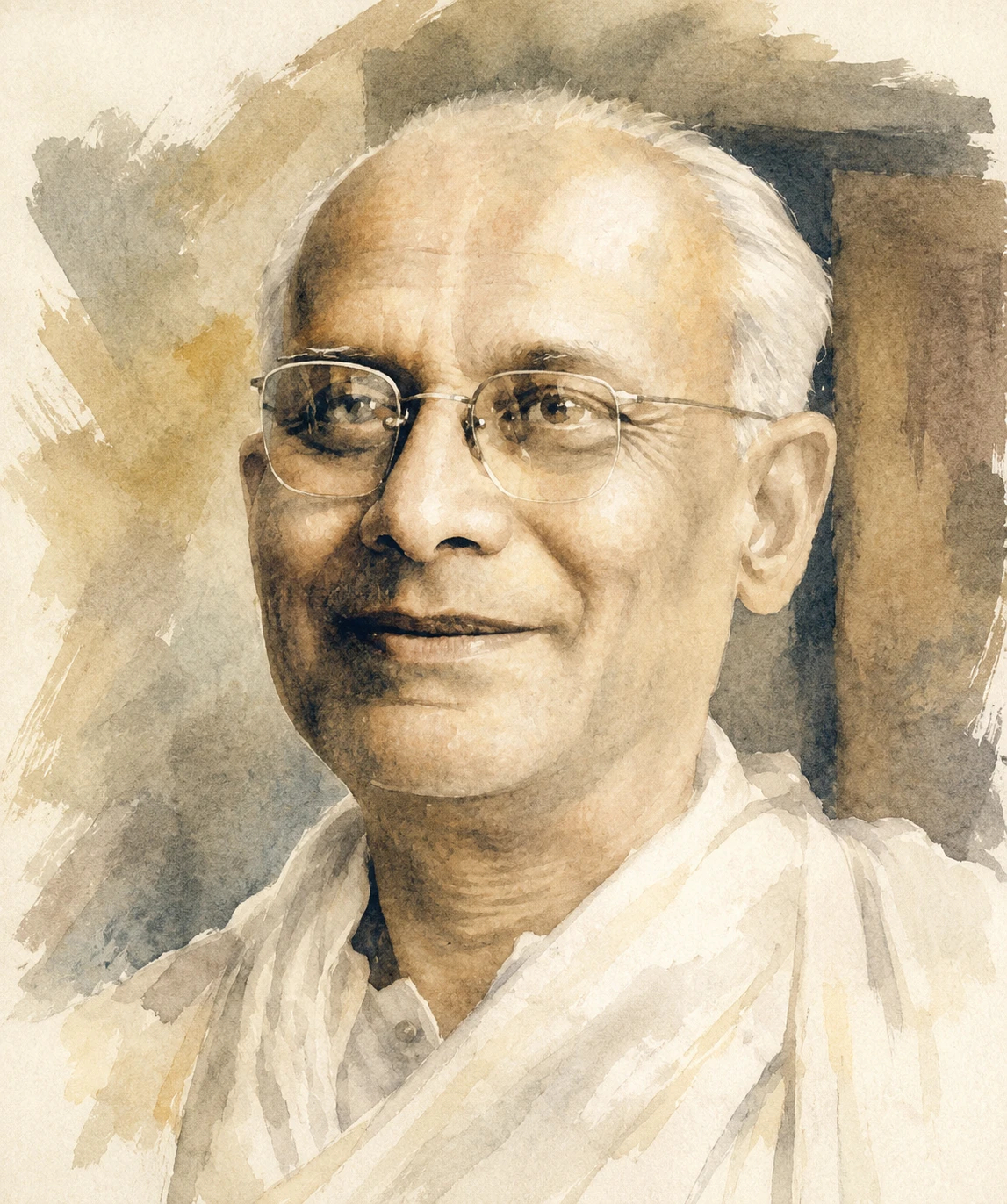
Rathindranath was the heir to Rabindranath’s estate and held office at Visva-Bharati when the transfer process began. What the government wanted from him was the working copyright in the vocal version of the song — the sung tune, as distinct from the orchestral and military band arrangements. Without it, no gramophone company could legally manufacture a record of anyone singing the national anthem, and no school could be sent one.
Five versions of one song
Who held the rights in 1950 — and what reached the schools| Version | Rights in 1950 | What reached the schools |
|---|---|---|
| The words | Freely reproducible | Printed in Devanagari, one anna a copy |
| Military band score | In official use | Boosey & Hawkes, London, 1952. Rs. 5-8-0 the set |
| Symphony orchestra score | Mr. Murrill | Freed 2 May 1951, printed 1952–53 |
| Piano score | Mr. Murrill | Freed 2 May 1951, printed 1952–53 |
| The sung tune | Visva-Bharati / Rathindranath Tagore | Nothing. Never mentioned in the file after April 1951 |
He did not refuse, and he did not ignore Delhi. He took advice.
According to documents preserved in the National Archives of India, the matter was discussed personally, several times, with Rathindranath Tagore — and also with Mr. Justice S. R. Das of the Supreme Court, whom Tagore brought in for informal consultation. An agreement form, drawn up in consultation with the Law Ministry, was sent to him for signature on 16 March 1951. He wrote back signifying his willingness to transfer the copyright. And then he made certain changes to the agreement form, which meant referring the whole thing back to the Law Ministry for fresh comments.
Delhi found this intolerable.
On 4 April 1951, S. N. Chib of the Directorate General, All India Radio, set out the position in an official note. It had not been possible so far, he wrote, to supply music publishers and gramophone recording companies with copies of the authorised version of Janaganamana, because in spite of best efforts and persuasion Visva-Bharati had still not transferred the copyrights in the song to the government.
Then paragraph two:
It is difficult to say, however, when these copyright [arrangements] will be finally completed because the Vishwabharti [people] have been procrastinating for several months now. We are [doing] our best in the matter but in case the matter is not finalized [about] the middle of April, 1951, we may have to request the Govt. [to take] such further suitable action as they may consider necessary.
The sheet in the file is a trimmed photocopy and the first few characters of every line are lost; the words in brackets are the obvious ones. The spellings are the file’s own. Nobody in this correspondence, over three years, manages to spell Visva-Bharati the same way twice.
Paragraph three is the one that explains what the deadlock actually cost. Even if AIR were given the funds to print the scores, Chib noted, no useful purpose would be served by distributing them to publishers or gramophone companies, because they would not be able to issue the scores or records on a commercial basis until the copyright restrictions were removed.
Fifteen months after the Constituent Assembly adopted it, the Republic had a national anthem it could not legally press onto a record.
And in a school in Gwalior, or Shillong, or Bhuj, a teacher who wanted to teach thirty children the correct tune had no way of finding out what it was.
How the file began
The file that records all this — 228 pages, Ministry of Education, opened in 1950 — was not opened to sort out a copyright. It was opened because Maulana Azad wanted children to sing.
The first document in it is a note in Urdu, in the Education Minister’s own hand, with a typed English translation clipped behind. Azad is thinking about France. In almost every country in the world, he writes, the national anthem is learnt by all the children in the schools, and they sing it with enthusiasm. You can hardly find a schoolboy in France who does not know La Marseillaise by heart and cannot sing it, alone or in chorus, in the tune set for it.
No such practice could be introduced in Indian schools, he goes on, because during the British regime no national anthem was adopted. At Congress meetings Vande Mataram was undoubtedly sung as a national anthem, but its use was confined to the Congress and connected institutions. Now the government has adopted Tagore’s song, and there is no reason why our schools should remain deprived of the pleasure and effect of the tune.
He does not think this can be left to the states. The matter is of great importance from a national point of view; the Centre should decide, and a uniform system should be adopted throughout the length and breadth of the country.
Then the picture he actually wants. All schools should introduce the system that the children stand in a circle before the beginning of classes and all of them sing the National Anthem in chorus. And it should be impressed upon them, he adds, that it is not for the teachers and a few students to sing while the rest simply listen. Every child should know it by heart and be able to sing it in its proper tune.
Secretary may please take necessary action in this direction.
Signed: Azad.
There is a small slip in the typed translation that turns out to be prophetic. In the second numbered point, the song is rendered as “Jana Mana Gana.” The Ministry of Education, in the very act of proposing to standardise the national anthem, had the words in the wrong order.
The discovery
Necessary action ran into a wall five pages later, and the wall was not political. It was procedural, which is much harder to argue with.
An officer, having consulted All India Radio, recorded the position. AIR had the authorised tune and melody record and could supply it. But there was no authorised version of the song in gramophone records at all. The nearest thing in existence was HMV record No. 27829, which he described as being based on the Visva-Bharati tune.
The Home Ministry, consulted next, explained why. Permission had not been granted to commercial firms to use the official version. The question was under active consideration. It also took the opportunity to remind everyone that the anthem was not to be played on parades or ordinary functions and should not be made to appear too cheap — an instruction sitting some distance from Azad’s vision of a school yard full of nine-year-olds singing it every morning.
Then, from the Ministry of Information and Broadcasting, the sentence that reframed the whole file.
Only the military band version had so far been played on official and ceremonial occasions. Steps were being taken to obtain copyright of the orchestral and the vocal versions from the parties concerned — namely, Mr. Murrill and Shri Rathindranath Tagore of Visva-Bharati respectively. Until the copyrights were secured, the versions could not be supplied to recording companies, and no standard form of the vocal version would be available for schools and colleges.
In January 1950 the Constituent Assembly adopted Jana Gana Mana as the national anthem of the Republic. Eight months later, the Government of India discovered that the right to record people singing it belonged to somebody else. Two somebody elses, in fact: an English composer for the orchestral arrangement, and a university in Birbhum for the tune the country actually sang.
Nobody in these papers is remotely scandalised by this. They are civil servants. They simply set about acquiring it.
An anthem cut in half
Part of what made the acquiring so slow is that the anthem had been divided — not metaphorically, but administratively, between two arms of government that each thought the other half was somebody else’s business.
Asked to clarify what it meant by an “authorised version,” All India Radio replied that the question needed splitting. Did it refer to the musical rendering, or to the text? Because AIR, it noted, was not concerned with the text.
So the tune became AIR’s department: the harmonised orchestral rendering already in use, and a new vocal version in the Indian tune, to run three minutes so that it would fit one side of a gramophone record. The words became somebody else’s entirely. They went to the Publications Division of the Ministry of Information and Broadcasting, which printed the first stanza in Devanagari with the notation and sold the folder at one anna a copy; the Education Ministry then posted it out to state education departments, fielding requests for fifty copies here and a dozen there.
Two ministries, each holding one half of a song. This worked adequately right up to the moment somebody asked for both halves at once, on a single object, which is what a gramophone record is.
Notes in the margin
The bad temper this generated is preserved in the margins, and the margins are where the file is most alive.
Consider the sequence in April 1951. Chib writes his procrastination note on the fourth. It goes up to I&B, and on to the Education Ministry, where an Under Secretary sees it on the tenth. Six days later the Education Ministry’s Deputy Secretary, Syed Ashfaque Husain, makes a helpful offer: if I&B so wish, his ministry would be willing to make an informal approach to Mr. Tagore and persuade him to agree — if we know what the difficulties are.
They had been told what the difficulties were. The note explaining them had crossed his own ministry’s desk the previous week.
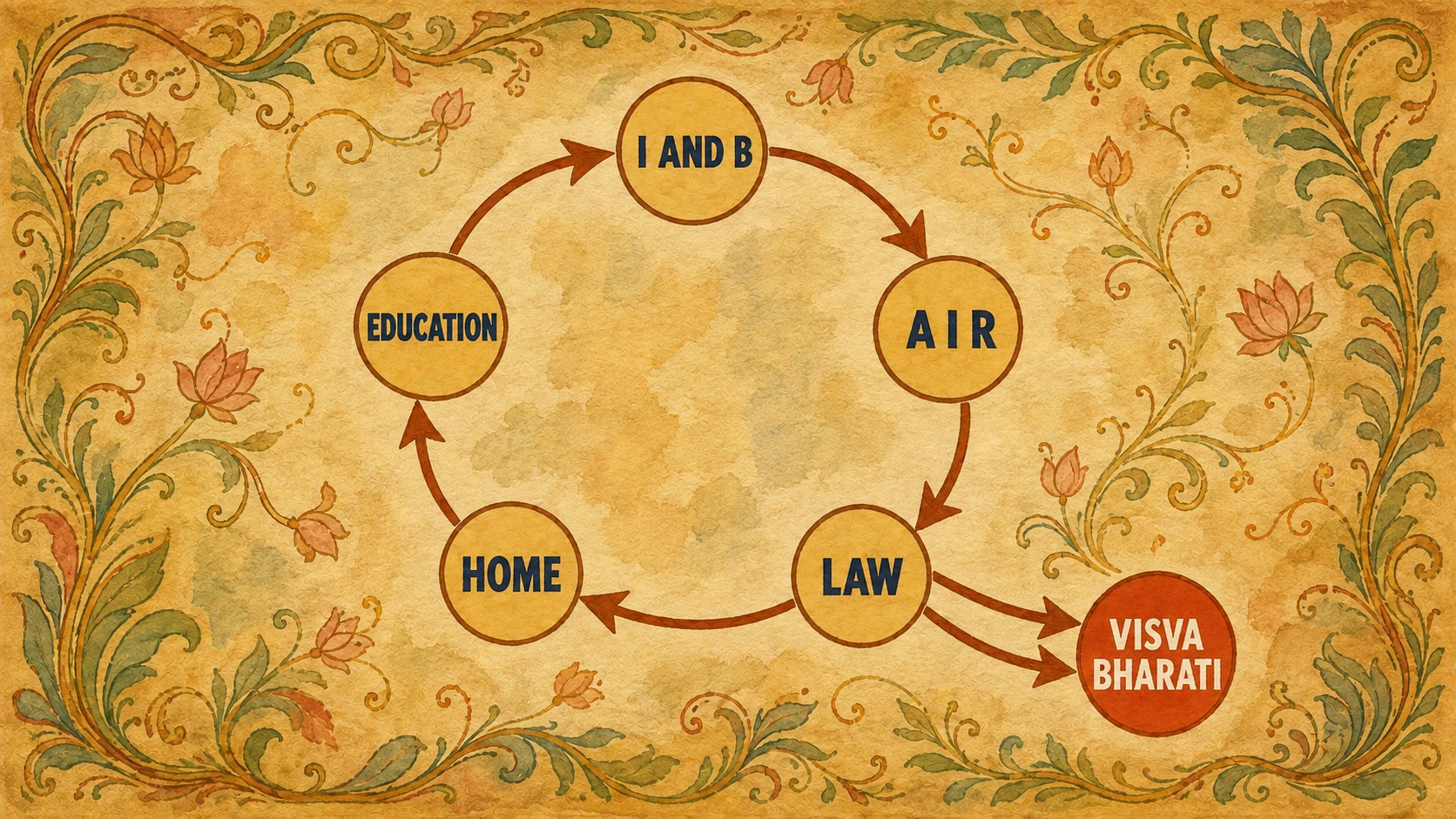
I&B duly forwards the offer to AIR: does the Director General require the help of the Education Ministry in persuading Visva-Bharati to transfer the copyrights? This may kindly be treated as urgent.
AIR replies on 21 April, and the reply is a masterclass in the polite closing of a door. A self-contained note was circulated. A meeting was held about ten days ago. A letter has been issued by the Home Ministry to Shri Rathindranath Tagore. The Deputy Secretary is aware of the whole position. And then: the Education Ministry will come into the picture only when other issues have been settled.
Husain’s response, four days later, has an edge you can feel through the paper. His offer of help, he notes, was made only if I&B would help. They apparently do not. Nonetheless he is extremely interested in an early settlement. He does not recollect having seen the self-contained note which AIR says was sent to them. Nor does he know what transpired at the meeting referred to. He would be grateful if somebody could throw some light, so that the matter can be followed. It is urgent from his point of view.
Underneath, in another hand, P. N. Kirpal offers the most quietly devastating line in 228 pages. The previous papers, he suggests, are probably in A.2, which deals with the subject of Copyright.
A further note asks the office to kindly see whether they have the papers at all.
There is one more piece of marginalia worth having, from two years later, when an officer in I&B was drafting a note about a private firm’s anthem chart. He typed the sentence Incidentally it may be pointed out that this Ministry was hardly concerned, looked at it, and struck it out — and then forwarded the file anyway, with the strikethrough perfectly legible to whoever opened it next. It is the most honest thing in the file.
What Rathin-babu may have been protecting
The file never records what changes Rathindranath made to the agreement form. But it does record, in some detail, what was happening to his father’s song while he was reading the draft.
On 8 January 1951 the Director of Public Instruction of Assam wrote to Ashfaque Husain from Shillong. Enquiries were coming in from educational institutions across the state about the correct form of the anthem and the notation of its tune. It was reported, he added, that for obvious reasons certain additions and alterations had been made in the National Anthem — the term Kamrupa inserted, and Sindhi dropped from the second line. If this was so, he would be grateful for a copy of the finally approved version, with printed notation, in English and in Hindi or Bengali, so that it could be circulated and the students and teachers could sing it correctly in the tune officially adopted.
The same instinct surfaces elsewhere in the file, from the other direction: local educational authorities telling a Delhi chart-printing firm that the word Sindhu had no business being in the song at all, since Sindh had gone to Pakistan.
So while an agreement form sat on a desk in Santiniketan, district officers in Assam were quietly swapping Kamrupa into the second line, and educational authorities elsewhere were quietly striking Sindhu out of it. Rabindranath had been dead less than ten years. His son was being asked to transfer the copyright in the song to a government that had not, on the evidence of its own file, managed to stop the words being edited in the field.
He was not being difficult. He was reading a contract carefully, with a Supreme Court judge advising him, and taking a few months over it. All India Radio called that procrastination. It is also what the rest of us would call due diligence.
The file, in its own hand
Two and a half years of notings- Sept 1950Azad’s note, in Urdu. Children should sing in chorus, in the proper tune.
- 18.9.1950Husain circulates every State: what is your practice?
- Oct 1950No authorised version exists on gramophone record. Nearest is HMV 27829.
- Nov 1950Copyright in the vocal version rests with Rathindranath Tagore of Visva-Bharati.
- 19.12.1950I&B: proposals for standardising a vocal chorus version under consideration.
- 11.1.1951Decided, with Home Affairs, to standardise the vocal version.
- 16.3.1951Agreement form sent to Rathindranath Tagore for signature.
- 4.4.1951Chib: Visva-Bharati “have been procrastinating for several months now.”
- 16.4.1951Education offers an informal approach. If we know what the difficulties are.
- 19.4.1951I&B to AIR. Treat as urgent.
- 21.4.1951AIR: Education will come into the picture only when other issues are settled.
- 25.4.1951Husain: They apparently do not.
- 26.4.1951Kirpal: the papers are probably in A.2, which deals with the subject of Copyright.
- 2.5.1951Home Ministry press communiqué. Text and staff notation freed. Vocal version not mentioned.
- 26.3.1952Boosey & Hawkes have the military band version in print.
- 20.9.1952Education asks I&B to ascertain the present position.
- 24.12.1952A further communication in the matter may be awaited.
- After April 1951The vocal version is never mentioned again in 228 pages.
Meanwhile, in the schools
The other half of the file is the half nobody planned. In September 1950 Husain circulated every state and Part B and Part C administration, asking what the practice was. Replies came in for two years, and together they are the best account we have of how the anthem was actually being sung in Indian classrooms while Delhi worked out who owned it.
There was no uniform practice. Some schools sang it at assembly, some at closing, some not at all. Madras had issued its own instructions in July 1949, six months before the Constituent Assembly adopted anything. Bhuj wrote in about “Jana Gana Mana Adhinayak.” Himachal Pradesh reported plainly that there was no uniform practice in its schools.
The suggestions are the suggestions of people improvising in the absence of a record. One state proposed that All India Radio, Calcutta, be instructed to broadcast the anthem daily at a fixed hour during school hours so that schools could sing along. Another suggested drawing up a list of teachers who knew music and were tolerably good singers, and distributing them among the schools so that each had at least one. A couple of good musicians might be sent in rotation to every school until some of the boys or the teachers could take it up. A three-day camp might be run for one teacher from each secondary school. In well-equipped schools, one official noted hopefully, the radio and the gramophone — or even the linguaphone — could come readily to the assistance of teachers.
Madhya Bharat had the most concrete idea, and the longest history. Writing from Gwalior in August 1951, its Director of Education pointed out that the question had been engaging his department since July 1948; orders had gone to all District Inspectors of Schools as far back as 30 July that year, with notification in the Gazette. The authorised notation had been secured from Visva-Bharati directly and copies distributed to all concerned.
So far as the words were concerned, he wrote, they would be taught to the boys — but the correct tune was even more important, and in villages the problem presented peculiar difficulties. His proposal: give each Assistant Inspector a portable gramophone and authorised records of the songs, to be carried on tour and played in the schools, so that the boys and girls could learn the words and the tune from the machine. If the proposal were accepted, he would submit a formal demand for the expenditure.
It was a good idea. It required exactly one thing that did not exist.
The Director of Public Instruction in Orissa put the same problem more simply, and without knowing he was doing it: the best way to bring the tune and the text to the notice of the schools, he suggested helpfully, would be to have a gramophone record prepared, which could be easily used in schools.
Nobody appears to have written back to explain why not.
Where the vocal version goes
Here is the thing that only becomes visible if you read all 228 pages in order.
The vocal version of Jana Gana Mana is discussed in this file five times. It appears when I&B says it is seeking the copyright from Rathindranath Tagore. It appears when AIR proposes standardising a vocal chorus version and asks permission for gramophone companies to record it. It appears when AIR specifies three minutes, one side of a record. It appears in Chib’s note of 4 April 1951.
After April 1951, it is never mentioned again.
What follows instead, over the next two years, is a steady procession of everything else. In March 1952, AIR reports that arrangements for printing, distribution and sale of the military band version have been made with Messrs Boosey & Hawkes Ltd., Music Publishers, 295 Regent Street, London W.1, and printed copies are available with them. Other scores, it adds, are not likely to be available for public sale for some time, as negotiations with music publishers are still in progress.
In September 1952 the Education Ministry — still, evidently, not in the picture — asks I&B to kindly ascertain the present position from the Director General, All India Radio.
Later that year: arrangements are being made for the printing of the piano version and the symphony orchestral version. Incidentally, it is mentioned, the score in staff notation for the military band version is available from Messrs Musical Mart, 5 East Street, Poona. The cost for a complete set is Rs. 5-8-0.
In December 1952, an officer in the Education Ministry minutes that a further communication in the matter, as promised by that Ministry, may be awaited.
And in March 1953, the matter is treated as settled by reference back to a Home Ministry press communiqué of 2 May 1951, which announced that publishers and gramophone manufacturing companies were free to publish the text and the score in staff notation — symphony orchestra, military band, and piano.
 RELEASED The text · symphony orchestra · military band · piano NOT MENTIONED The vocal version. Three minutes, one side of a record.
 - RELEASED — The text · symphony orchestra · military band · piano
- NOT MENTIONED — The vocal version. Three minutes, one side of a record.
Read that list one more time, because the list is the argument. Every arrangement named is instrumental. Three scores went to press over two years, and a school could buy the band parts from an agent in Poona for five rupees eight annas.
The one version that never went to press is the one you can sing.
Azad had asked for children standing in a circle before class, all of them singing in chorus, in the proper tune. What the Republic was able to hand them, three years later, was a piano reduction and a London publisher’s catalogue number.
 BOOSEY & HAWKES LTD 295 Regent Street, London W.1 MESSRS MUSICAL MART 5 East Street, Poona · Rs. 5-8-0 the set THE SCHOOL four and a half years after Independence
 - BOOSEY & HAWKES LTD — 295 Regent Street, London W.1
- MESSRS MUSICAL MART — 5 East Street, Poona · Rs. 5-8-0 the set
- THE SCHOOL — four and a half years after Independence
Coda: the chart-seller
The last act belongs to a stationery firm in Subzi Mandi.
The All India Educational Supply Co., of Jawahar Nagar, Delhi, described itself on its letterhead as being on the approved list of Union and Central Government departments, and as manufacturers and suppliers of geographical wall maps, charts, globes, apparatus, historical maps, educational pictures, drawing material, hygiene requisites, scientific apparatus, prize books, registers and library books, etc., etc.
In July 1952 the Prime Minister spoke at the Ramlila grounds in Delhi and laid emphasis on learning and properly singing Jana Gana Mana. To give effect to the Prime Minister’s speech, the firm printed a wall chart of the Rashtriya Geet and posted sample copies to the education departments of every state.
They were, their letter of 20 January 1953 records, surprised not to have received any encouraging response.
Instead, the Director of Education of Saurashtra kindly informed them that the song in their chart was an old one. Local educational authorities told them that the name of Sindhu State should not be there at all, as the same had seceded from India.
Their defence is unanswerable, and it is the whole file compressed into a paragraph. They had copied the text from Our National Songs, published by the Publications Division of the Ministry of Information and Broadcasting, Government of India. They had confirmed verbally with the Home Ministry that this was the latest publication on the national anthem and the sole and final authority on it.
Then, so that the Secretary could see the problem for himself, they set out two columns side by side.
Two columns, one anthem
Enclosed with the firm’s letter, January 1953Jana-Gana-Mana-Adhinayaka
Jaya he Bharata-bhagya-vidhata
Punjab-Sindhu-Gujrata-Maratha-
Dravida-Utkala-Banga
Vindhya-Himachala-Yamuna-Ganga
Uchchala-Jaladhi-Taranga
Tava Subha name jage
Tava Sucha asisa mage
Gahe tava jaya-gatha
Jana-Gana-Mana-Adhinayaka
Jaya he Bharat Bhagya Vidhata
Kamrup-Punjab-Maratha
Gurjar-Dravida-Vanga
Utkala-Vindhya-Himachala-Yamuna
Ganga Uchchala-Jaladhi-Tarang
Tava Shubha name jage
Tava shubha asisa mage
Gahe tava jaya gatha
The Prime Minister had asked the nation to sing the song properly, and a stationery firm had discovered that the nation could not agree on the words.
They wrote in January. They wrote again in February. They wrote again in June, each letter more elaborately courteous than the last, each noting that no reply had been received so far, each marked MOST URGENT.
The reply, when it came, was brief. It was regretted that the action suggested by them could not be taken.
What the record leaves out
The file ends without an ending. There is no signed agreement in these pages, no note recording that the vocal version was finally cleared, no moment at which anybody writes down what Rathindranath’s changes to the agreement form actually were. The correspondence simply thins out, the states stop writing, and the last stretch is about wall charts.
Two cautions are worth stating plainly. This is the Education Ministry’s file; the negotiation itself lived in I&B’s file 2(16)50-B.II and appears here only as extracts, forwarded copies and second-hand notes. And a handful of pages in it are handwritten routing slips that no amount of squinting will resolve. What we have is a keyhole, not a room.
But through the keyhole the shape is unmistakable, and anyone who has ever filed an RTI application will recognise it. A minister asks for something reasonable. The request meets a right nobody thought about. The right belongs to a private party who is entirely within his rights to read the contract carefully, and who cannot be compelled. The machinery, unable to move him, quietly redefines the problem into the shape of the thing it can already do — and announces that as the solution.
The anthem was adopted in January 1950. The scores went to press in 1952 and 1953. And somewhere in between, without anyone recording the decision, the Government of India stopped trying to make a record of the song being sung.
The children went on singing it anyway, in whatever tune their teacher happened to know.
Ministry of Education, Government of India, File No. F.49-III/50-D.3, “National Anthem — Singing of the song ‘Jana Gana Mana’ in all Schools and Colleges”, 228 pages, National Archives of India. Correspondence with the Ministry of Information and Broadcasting appears as extracts from I&B File No. 2(16)50-B.II. The cover sheet carries the annotation “Destroy in 1958.”